English
 Español
 tiếng việt
 русский
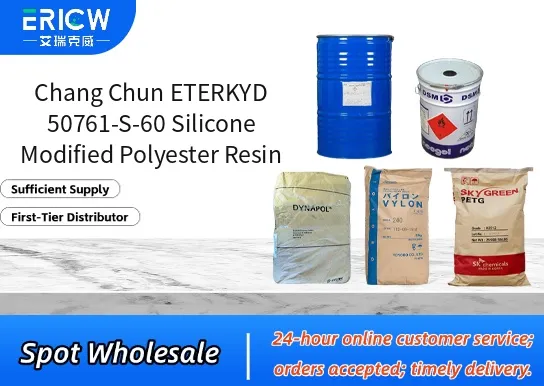
Enhanced thermal stability due to silicone incorporation, enabling sustained performance at elevated temperatures.
Improved weather resistance and UV durability compared to conventional polyester resins.
Excellent compatibility with melamine formaldehyde crosslinkers for high-gloss, durable thermoset coatings.
Good flow and leveling characteristics, supporting smooth film formation in coil and appliance coating applications.
Reduced surface tension for enhanced substrate wetting and intercoat adhesion on metal substrates.
Pre-treatment and topcoat formulations for architectural metal roofing and wall panels.
High-performance coil coatings for HVAC components and building cladding systems.
Durable appliance coatings for refrigerators, washing machines, and ovens.
Industrial maintenance coatings requiring long-term gloss retention and chalking resistance.
Functional primers for aluminum and galvanized steel substrates in outdoor exposure environments.
| Chemical Type | Silicone-modified polyester resin (thermosetting) |
| Product Form | Clear to pale yellow viscous liquid |
| Appearance | Homogeneous, free from visible gels or sediment |
| Solids Content (wt%) | 60 ± 1% (in xylene/butyl acetate blend) |
| Acid Value (mg KOH/g) | 18–22 |
| Viscosity (25°C, mPa·s) | 4,500–6,500 (Brookfield RV, spindle #3, 20 rpm) |
| Gardner Color | ≤ 3 |
| Primary Applications | Coil coatings, appliance finishes, architectural metal coatings |
Q1: What is the primary functional benefit of silicone modification in this polyester resin?
A: The silicone modification enhances thermal stability, improves surface slip and mar resistance, and contributes to better weatherability and gloss retention—particularly valuable in high-performance coil coating and exterior architectural finishes.
Q2: Is ETERKYD 50761-S-60 compatible with standard polyester crosslinkers such as TGIC or HAA systems?
A: Yes, it is formulated for compatibility with common amino- and hydroxy-functional crosslinkers, including TGIC, β-hydroxyalkylamide (HAA), and melamine-based curing agents—enabling flexible formulation design for both coil and general industrial coatings.
Q3: How does this resin perform in terms of UV resistance compared to conventional polyester resins?
A: Due to the silicone moiety’s inherent resistance to UV degradation and oxidative stress, ETERKYD 50761-S-60 delivers significantly improved long-term color and gloss retention under outdoor exposure—making it well-suited for demanding exterior applications where durability is critical.
Q4: Can this resin be used in low-bake or ambient-cure formulations?
A: While optimized for standard cure profiles (e.g., 200–240 °C for 15–30 seconds in coil coating), it can be adapted to lower-temperature cure systems with appropriate crosslinker selection and catalyst optimization—though performance trade-offs in hardness and chemical resistance should be evaluated case by case.
Contact With Us:
E-mail: wangxingqiang@ericwchem.com
Have a Questions? Call Us:
Add:
Building A1, Jiete Industrial Park, Huangpu District, Guangzhou City, Guangdong Province, China