English
 Español
 tiếng việt
 русский
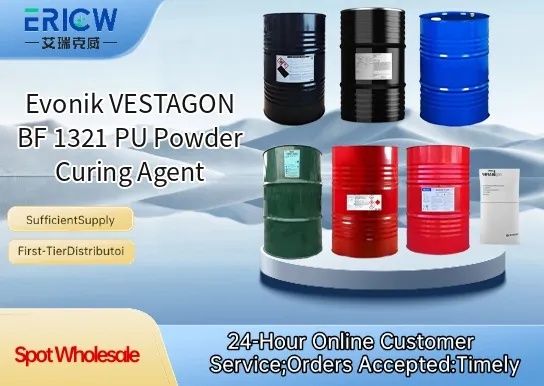
High reactivity with hydroxyl-functional polyester and acrylic powder resins for fast cure at low temperatures.
Enables excellent mechanical properties including hardness, flexibility, and chemical resistance in cured coatings.
Low volatility and non-yellowing performance ensure superior color stability and long-term durability.
Designed for 100% solids powder systems — zero VOC emissions and compliant with stringent environmental regulations.
Consistent particle size distribution supports smooth electrostatic application and uniform film formation.
Architectural aluminum extrusions for curtain walls and window frames.
Automotive exterior trim and under-hood components requiring thermal and chemical resilience.
Industrial appliances such as ovens, refrigerators, and HVAC enclosures.
Office furniture and metal office partitions with high aesthetic and scratch resistance demands.
Outdoor lighting fixtures and street furniture exposed to UV and weathering.
| Chemical Type | Blocked aliphatic polyisocyanate (uretdione-type) |
| Product Form | Free-flowing white to off-white powder |
| Appearance | Homogeneous crystalline powder |
| Primary Applications | Curing agent for hydroxyl-functional polyester and acrylic powder coatings |
| Key Features | Low-cure temperature capability (160–180 °C), high storage stability, excellent flow and leveling |
| Benefits | Reduced energy consumption, enhanced edge coverage, improved gloss retention |
| Storage Conditions | Store in cool, dry place below 25 °C; protect from moisture and direct sunlight |
| Shelf Life | 12 months from date of manufacture when stored under recommended conditions |
Q1: What is the primary function of VESTAGON BF 1321 in polyurethane powder coatings?
A: VESTAGON BF 1321 is a blocked aliphatic diisocyanate-based curing agent specifically designed for thermosetting polyurethane (PU) powder systems. It enables crosslinking of hydroxyl-functional resins at elevated temperatures, delivering excellent gloss retention, mechanical durability, and weather resistance in the cured film.
Q2: How does BF 1321 compare to aromatic curing agents in terms of yellowing resistance?
A: As an aliphatic blocked isocyanate, BF 1321 offers significantly improved UV stability and minimal yellowing upon exposure to light and heat—making it preferred over aromatic alternatives for high-gloss, exterior-grade, or white/light-colored PU powder coatings where long-term color stability is critical.
Q3: What is the typical activation temperature range for BF 1321 in standard curing cycles?
A: BF 1321 is formulated for thermal deblocking in conventional powder coating ovens. Its effective crosslinking onset generally begins around 150 °C, with full cure typically achieved within standard industrial schedules at 160–180 °C for 10–20 minutes—though exact conditions depend on substrate, film thickness, and oven type.
Q4: Is BF 1321 compatible with common polyester and acrylic hydroxyl resins used in PU powders?
A: Yes—BF 1321 is broadly compatible with standard hydroxyl-terminated polyester and acrylic resins employed in decorative and functional PU powder formulations. Compatibility and reactivity should be confirmed via small-scale formulation trials under intended processing conditions.
Q5: How should BF 1321 be incorporated into a powder coating formulation?
A: BF 1321 is typically dry-blended with the base resin, pigments, and additives prior to extrusion. Due to its reactive nature, it should be handled under low-humidity conditions and processed promptly after blending to avoid premature moisture uptake or degradation. Dosage depends on formulation requirements but generally ranges from 0.1% to 2% by weight relative to total solids.
Contact With Us:
E-mail: wangxingqiang@ericwchem.com
Have a Questions? Call Us:
Add:
Building A1, Jiete Industrial Park, Huangpu District, Guangzhou City, Guangdong Province, China