English
 Español
 tiếng việt
 русский
Highly selective for monovalent anions, especially chloride and nitrate, enabling precise removal in complex matrices.
Optimized macroporous polystyrene-divinylbenzene matrix ensures excellent chemical and osmotic stability across wide pH and temperature ranges.
Low pressure drop and high hydraulic throughput due to uniform spherical bead morphology (0.4–1.2 mm) and narrow particle size distribution.
USP Class VI and FDA-compliant for use in pharmaceutical water purification and food-grade process streams.
Regenerable with standard sodium chloride solutions, supporting sustainable operation and reduced waste generation.
Pharmaceutical-grade purified water (PW) and water for injection (WFI) polishing in GMP-compliant facilities.
Nitrate and sulfate removal from municipal and industrial drinking water supplies.
Pre-treatment for reverse osmosis (RO) systems to protect membranes from anionic fouling.
Electronics industry ultrapure water (UPW) final polishing for semiconductor manufacturing.
Food and beverage process water dechlorination and residual anion control.
| Chemical Type | Strong Base Anion Exchange Resin (Type I, Quaternary Ammonium) |
| Product Form | Moist, spherical beads |
| Appearance | Off-white to light yellow, translucent beads |
| Functional Group | Triethylbenzylammonium |
| Matrix Structure | Macroporous polystyrene-divinylbenzene copolymer |
| Particle Size Range | 0.4–1.2 mm |
| Moisture Content | 48–55% (as shipped) |
| Maximum Operating Temperature | 60 °C |
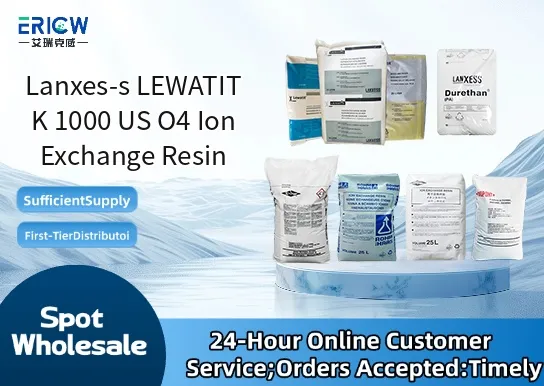
Q1: What is the primary functional group and ionic form of Lanxes-s LEWATIT K 1000 US O4?
A: Lanxes-s LEWATIT K 1000 US O4 is a strongly basic anion exchange resin in the hydroxide (OH⁻) form, featuring quaternary ammonium functional groups grafted onto a styrene-divinylbenzene matrix.
Q2: Is this resin suitable for pharmaceutical or food-grade water purification applications?
A: Yes — Lanxes-s LEWATIT K 1000 US O4 is manufactured and tested to meet stringent quality requirements for use in high-purity water systems, including those supporting pharmaceutical processing and food-grade applications, subject to appropriate validation and regulatory compliance by the end user.
Q3: How does this resin compare to standard gel-type strong base anion resins in terms of chemical stability?
A: Lanxes-s LEWATIT K 1000 US O4 exhibits enhanced oxidative and osmotic stability due to its macroporous structure and optimized crosslinking, making it particularly robust under demanding regeneration cycles and in feedwaters containing oxidants or fluctuating ionic strength.
Q4: What regeneration chemicals are recommended for this resin?
A: Sodium hydroxide (NaOH) is the standard regenerant. Optimal concentration and dosage depend on service conditions, but typical regeneration uses dilute NaOH solutions — generally ranging from 2% to 4% w/w — with careful attention to flow rate and contact time to ensure complete functional group recovery.
Contact With Us:
E-mail: wangxingqiang@ericwchem.com
Have a Questions? Call Us:
Add:
Building A1, Jiete Industrial Park, Huangpu District, Guangzhou City, Guangdong Province, China