English
 Español
 tiếng việt
 русский
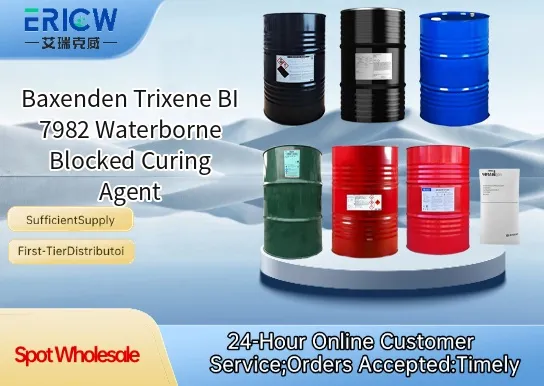
Waterborne formulation enabling low-VOC, environmentally compliant coating systems.
Thermally blocked isocyanate functionality providing excellent shelf stability at ambient temperatures.
Efficient crosslinking with hydroxyl-functional resins (e.g., acrylics, polyesters) upon thermal activation (~130–150 °C).
Good compatibility with a broad range of waterborne dispersions and co-solvent systems.
Delivers enhanced hardness, chemical resistance, and film integrity in cured coatings.
Industrial maintenance coatings for metal substrates.
Automotive OEM and refinish clearcoats and basecoats.
Wood finishing coatings requiring low-temperature cure flexibility.
General-purpose waterborne coil coatings.
Plastic coatings where substrate heat sensitivity limits cure temperature.
| Chemical Type | Blocked aliphatic polyisocyanate dispersion |
| Product Form | Aqueous dispersion |
| Appearance | Opaque white to off-white liquid |
| Primary Applications | Waterborne thermoset coatings for metal, wood, and plastic |
| Key Features | Low VOC, thermal deblocking, ambient storage stability |
| Benefits | Reduced emissions, improved pot life, robust film performance |
| pH (10% aqueous dilution) | 7.5 – 8.5 |
| Solids Content (wt%) | 40 – 44 |
Q1: What is the primary function of Trixene BI 7982 in waterborne coating systems?
A: Trixene BI 7982 is a waterborne, blocked aliphatic polyisocyanate curing agent designed to provide ambient- or low-bake crosslinking for hydroxyl-functional waterborne resins. It delivers excellent film hardness, chemical resistance, and gloss retention without requiring high-temperature cure cycles.
Q2: How does the blocking chemistry of BI 7982 affect its storage stability and handling?
A: The blocked isocyanate groups in BI 7982 remain inert under ambient conditions, enabling extended shelf life in neutral-to-slightly-alkaline aqueous dispersions. It exhibits good compatibility with common waterborne acrylics and polyurethane dispersions, and does not require special moisture protection during standard handling and storage.
Q3: What types of resins is BI 7982 typically compatible with?
A: BI 7982 is formulated for use with hydroxyl-functional waterborne acrylics, polyester dispersions, and hybrid polyurethane-acrylic systems. Compatibility should always be verified experimentally, as performance may vary depending on pH, ionic character, and particle size distribution of the base resin.
Q4: What is the typical activation temperature range for full crosslinking?
A: Full deblocking and crosslinking generally occur between 100 °C and 140 °C, depending on formulation pH, catalyst presence, and thermal exposure time. Some degree of reactivity may be observed at lower temperatures when combined with suitable catalysts or extended dwell times.
Contact With Us:
E-mail: wangxingqiang@ericwchem.com
Have a Questions? Call Us:
Add:
Building A1, Jiete Industrial Park, Huangpu District, Guangzhou City, Guangdong Province, China