English
 Español
 tiếng việt
 русский
Excellent soft-touch feel with balanced elasticity and compression set resistance.
Good processability on standard injection molding and extrusion equipment.
Enhanced adhesion to polypropylene (PP) and polyethylene (PE) substrates without primer.
RoHS-compliant formulation with no added phthalates, heavy metals, or halogens.
Stable color retention and UV resistance suitable for indoor and limited outdoor applications.
Automotive interior trim components including door panels and instrument bezels.
Consumer electronics housings and protective overmolded grips.
Household appliance seals, gaskets, and soft-touch control buttons.
Medical device ergonomic handles and non-sterile wearable interfaces.
Industrial tool overmolding for improved grip and impact absorption.
| Chemical Type | Thermoplastic Elastomer (TPE), SEBS-based |
| Product Form | Pellets |
| Appearance | Opaque beige granules |
| Hardness (Shore A) | 40 ± 3 |
| Melt Flow Rate (230°C/2.16 kg) | 18–22 g/10 min |
| Density | 0.90–0.92 g/cm³ |
| Tensile Strength | 5.5–6.5 MPa |
| Elongation at Break | 450–550 % |
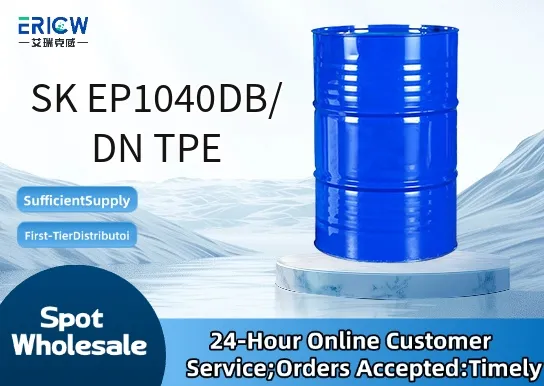
Q1: What is the primary function of SK EP1040DB/DN TPE in thermoplastic elastomer formulations?
A: SK EP1040DB/DN TPE is a specialized processing aid and performance modifier designed to enhance melt flow, reduce extrusion torque, and improve surface finish in TPE compounds—particularly in styrenic block copolymer (TPE-S) and thermoplastic polyolefin (TPO)-based systems.
Q2: Is SK EP1040DB/DN TPE compatible with common TPE base polymers such as SEBS, SBS, and PP/EPDM blends?
A: Yes, it demonstrates broad compatibility with major TPE base resins including hydrogenated (SEBS) and non-hydrogenated (SBS) styrenic block copolymers, as well as polypropylene- and ethylene-propylene-diene monomer-based TPOs. Compatibility is typically confirmed through melt blending trials and rheological evaluation.
Q3: How should SK EP1040DB/DN TPE be incorporated into a TPE formulation?
A: It is generally introduced during the compounding stage—either pre-blended with polymer pellets or fed directly into the extruder feed throat. Typical usage levels range from 0.1% to 2% by weight, depending on the base formulation, desired processing improvement, and final part requirements.
Q4: Does SK EP1040DB/DN TPE affect the mechanical properties or long-term stability of finished TPE parts?
A: When used within recommended dosage ranges, it does not significantly compromise tensile strength, elongation, or hardness. Its chemical structure is selected for thermal and oxidative stability under standard TPE processing conditions, supporting consistent performance in both primary and secondary processing steps.
Contact With Us:
E-mail: wangxingqiang@ericwchem.com
Have a Questions? Call Us:
Add:
Building A1, Jiete Industrial Park, Huangpu District, Guangzhou City, Guangdong Province, China