English
 Español
 tiếng việt
 русский
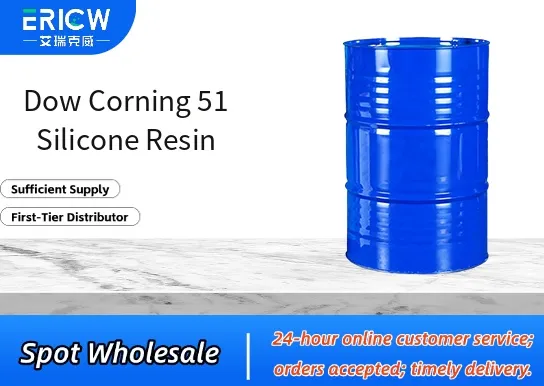
High thermal stability with continuous service capability up to 200 °C.
Excellent electrical insulation properties across wide temperature and frequency ranges.
Good compatibility with organic resins, pigments, and fillers for hybrid formulation systems.
Low surface energy enabling effective release performance in mold coatings and anti-stick applications.
Solvent-based liquid form facilitating easy integration into conventional coating and impregnation processes.
Electrical insulation coatings for transformers, motors, and generators.
Heat-resistant topcoats for industrial exhaust systems and furnace components.
Release agents for composite manufacturing and rubber molding.
Binders in high-temperature pigment systems for ceramic and metal coatings.
Matrix resins in silicone-modified organic varnishes and enamel formulations.
| Chemical Type | Methyl-phenyl silicone resin |
| Product Form | Liquid (solvent solution) |
| Appearance | Clear, colorless to pale yellow liquid |
| Solvent System | Aromatic hydrocarbons (e.g., xylene) |
| Solids Content | Approximately 60–65 wt% |
| Viscosity (25 °C) | 100–300 cP |
| Flash Point (Tag Closed Cup) | Approx. 40–45 °C |
| Primary Applications | High-temperature coatings, electrical insulation, release systems |
Q1: What is the primary function of Dow Corning 51 Silicone Resin in coating and ink formulations?
A: Dow Corning 51 Silicone Resin is primarily used as a surface modifier to enhance slip, mar resistance, and substrate wetting. It migrates to the film surface during drying/curing, forming a low-energy layer that improves tactile feel and reduces friction without significantly affecting bulk film properties.
Q2: Is Dow Corning 51 compatible with common organic solvent-based systems?
A: Yes, it exhibits good compatibility with a wide range of organic solvents—including aromatic hydrocarbons, ketones, and esters—and is frequently incorporated into solvent-borne acrylics, polyurethanes, and alkyd resins. Compatibility should be verified in the final formulation due to potential interactions with reactive components or additives.
Q3: How is Dow Corning 51 typically incorporated into a formulation?
A: It is generally added during the let-down stage under moderate agitation. Pre-dilution in a compatible solvent may aid dispersion. Due to its low surface tension, high-shear mixing is not required, and over-mixing should be avoided to prevent excessive air entrapment.
Q4: Does Dow Corning 51 affect cure chemistry or crosslinking in thermosetting systems?
A: While chemically inert under typical processing conditions, it may influence surface cure kinetics in some systems—particularly those relying on oxygen-sensitive mechanisms—due to surface segregation. Formulators should evaluate intercoat adhesion, through-cure, and final hardness when using it in crosslinked coatings.
Contact With Us:
E-mail: wangxingqiang@ericwchem.com
Have a Questions? Call Us:
Add:
Building A1, Jiete Industrial Park, Huangpu District, Guangzhou City, Guangdong Province, China