English
 Español
 tiếng việt
 русский
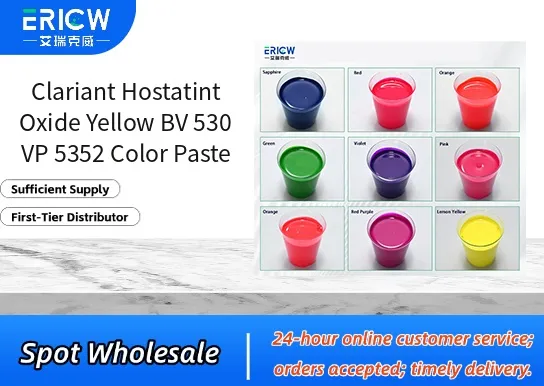
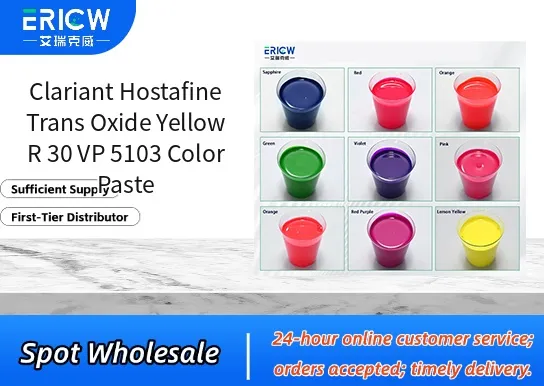
High chroma, lightfast oxide yellow pigment dispersion with excellent color strength and consistency.
Optimized for low viscosity and superior rheological behavior in water-based systems.
Excellent compatibility with common acrylic, styrene-acrylic, and vinyl emulsion polymers.
Free of APEOs, heavy metals, and REACH-compliant for sustainable industrial use.
Stable dispersion with minimal settling and long shelf life under recommended storage conditions.
Architectural coatings including interior and exterior wall paints.
Industrial maintenance coatings for metal and concrete substrates.
Water-based wood finishes and primers.
Plaster and render colorants for mineral-based decorative systems.
Non-food-contact plastic coloration (e.g., PP, PE, PVC) via masterbatch dilution.
| Chemical Type | Inorganic iron oxide pigment dispersion |
| Product Form | Ready-to-use liquid color paste |
| Appearance | Homogeneous, viscous yellow paste |
| Primary Applications | Water-based architectural and industrial coatings |
| Key Features | High opacity, low dusting, easy dispersion |
| Benefits | Reduced formulation complexity, consistent batch-to-batch color match |
| Recommended Storage | 5–30 °C, protected from freezing and direct sunlight |
| Shelf Life | 24 months from date of manufacture when stored properly |
Q1: What is the primary application field for Hostatint Oxide Yellow BV 530 VP 5352?
A: This pigment paste is specifically developed for coloring thermoplastic polymers, especially polyolefins such as PP and PE, where high thermal stability, excellent dispersion, and consistent hue reproducibility are required during extrusion or injection molding.
Q2: Is this color paste suitable for food-contact applications?
A: Hostatint Oxide Yellow BV 530 VP 5352 is formulated to meet general regulatory expectations for indirect food contact in plastics, subject to final compliance verification by the compounder or end-user under applicable regional frameworks. It contains no intentionally added heavy metals or restricted aromatic amines.
Q3: How should the paste be incorporated into polymer systems?
A: It is typically introduced via masterbatch dilution or direct addition during compounding. Good mechanical mixing and adequate melt residence time ensure optimal dispersion; pre-drying is not required, but storage under dry, cool conditions is recommended to maintain rheological consistency.
Q4: What is the typical dosage range for achieving standard opacity and chroma in polyolefins?
A: Dosage depends on formulation requirements and desired shade intensity, but it is generally used at low concentrations—typically ranging from 0.1% to 2% by weight relative to the base polymer—to achieve good color strength and uniformity without compromising mechanical properties.
Q5: Does this paste exhibit good resistance to migration and blooming in finished parts?
A: Yes—the oxide-based pigment system and optimized carrier matrix provide strong compatibility with polyolefins, resulting in low tendency toward migration, surface blooming, or plate-out under normal processing and service conditions.
Contact With Us:
E-mail: wangxingqiang@ericwchem.com
Have a Questions? Call Us:
Add:
Building A1, Jiete Industrial Park, Huangpu District, Guangzhou City, Guangdong Province, China