English
 Español
 tiếng việt
 русский
Excellent abrasion resistance for extended service life in demanding mechanical environments.
Outstanding elasticity and recovery performance across a wide temperature range (–40 °C to 80 °C).
Good resistance to oils, greases, and many common industrial chemicals.
High melt flow consistency enabling reliable processing via extrusion and injection molding.
Low compression set for durable sealing and dynamic cushioning applications.
Industrial rollers and conveyor belts requiring wear-resistant surfaces.
Automotive interior trim components including flexible overlays and soft-touch surfaces.
Protective casings and housings for electronic devices and power tools.
Technical hoses and fluid transfer tubing in pneumatic and hydraulic systems.
Footwear midsoles and performance outsoles demanding resilience and energy return.
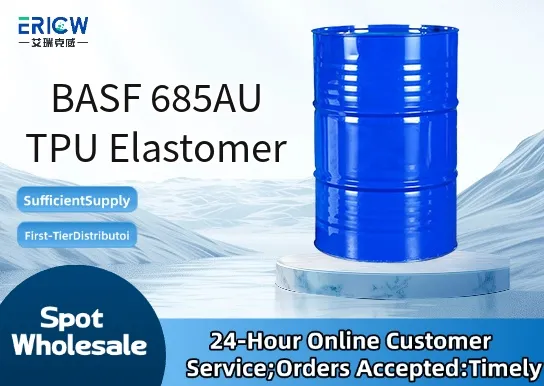
| Chemical Type | Aliphatic polyester-based thermoplastic polyurethane |
| Product Form | Pellets |
| Appearance | Off-white to light beige, free-flowing granules |
| Primary Applications | Extrusion, injection molding, calendering |
| Key Features | Abrasion resistance, elasticity, oil resistance, processability |
| Benefits | Long-term dimensional stability, low hysteresis, recyclable melt processing |
| Density (g/cm³) | 1.18–1.20 |
| Melt Flow Index (230 °C/2.16 kg, g/10 min) | 10–14 |
Q1: What is the primary processing method for BASF 685AU TPU Elastomer?
A: BASF 685AU is a thermoplastic polyurethane elastomer designed for melt-processing techniques, including extrusion, injection molding, and blow molding. It exhibits good melt stability and flow characteristics suitable for high-speed production of flexible profiles, films, and molded parts.
Q2: Is BASF 685AU compatible with common engineering plastics for alloying or overmolding?
A: Yes, BASF 685AU demonstrates good compatibility with several engineering thermoplastics such as polypropylene (PP), polyethylene (PE), and certain grades of polyamide (PA), especially when used in overmolding or blend applications requiring soft-touch surfaces or impact modification. Compatibility should be verified experimentally for specific formulation targets.
Q3: How does BASF 685AU perform under UV exposure and outdoor weathering?
A: BASF 685AU offers inherent resistance to UV degradation and maintains mechanical integrity during prolonged outdoor exposure. For extended service life in demanding outdoor applications, stabilization with appropriate UV absorbers or HALS additives is recommended based on end-use requirements.
Q4: Can BASF 685AU be used in food-contact or medical-related applications?
A: BASF 685AU is not pre-qualified for direct food-contact or medical device applications. Its suitability for such uses depends on full regulatory assessment—including migration testing, biocompatibility evaluation, and compliance with applicable regional regulations—conducted by the final product manufacturer.
Contact With Us:
E-mail: wangxingqiang@ericwchem.com
Have a Questions? Call Us:
Add:
Building A1, Jiete Industrial Park, Huangpu District, Guangzhou City, Guangdong Province, China