English
 Español
 tiếng việt
 русский
Highly reflective aluminum pigment with controlled particle size distribution for consistent optical performance.
Optimized surface treatment for excellent dispersion stability in both solvent-based and water-based systems.
Superior weather resistance and UV stability, minimizing color shift and gloss loss in exterior applications.
Low oil absorption enabling high loading levels without compromising viscosity or film integrity.
Non-leafing type formulation ensures uniform orientation and homogeneous metallic effect in dried films.
Automotive OEM and refinish coatings requiring durable, high-gloss metallic finishes.
Industrial maintenance coatings for metal structures, bridges, and heavy equipment.
Plastic coloration for automotive trim, consumer electronics housings, and appliance components.
Architectural coatings including facade paints and decorative metallic wall finishes.
Printing inks for premium packaging and security applications demanding metallic brilliance.
| Chemical Type | Aluminum pigment (flaked) |
| Product Form | Paste in mineral spirits (non-aqueous) |
| Appearance | Silvery-gray, viscous paste with metallic sheen |
| Primary Applications | Metallic coatings, plastics, inks |
| Key Features | Non-leafing, surface-treated, medium brightness |
| Benefits | Enhanced dispersion, improved corrosion inhibition, low sedimentation |
| VOC Content | ≤ 350 g/L (as supplied) |
| Storage Stability | 12 months in original sealed container at 5–30 °C |
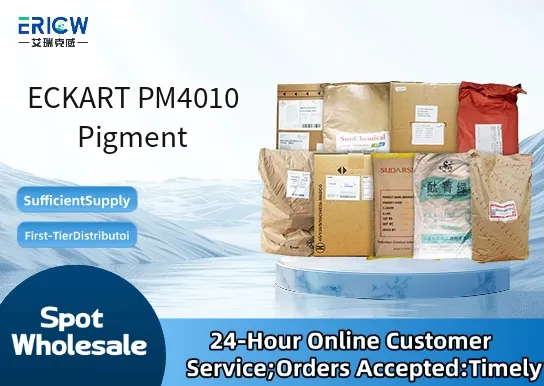
Q1: What is the primary function of ECKART PM4010 Pigment in coating and ink formulations?
A: ECKART PM4010 is a high-performance pearlescent pigment based on mica coated with titanium dioxide, designed to deliver bright, interference-based chromatic effects—such as soft iridescence and elegant color travel—while maintaining excellent lightfastness and chemical stability in solvent- and water-based systems.
Q2: Is ECKART PM4010 suitable for use in automotive refinish coatings?
A: Yes, PM4010 is widely used in automotive refinish and OEM topcoats where premium visual effects and durability are required. Its platelet structure and optimized particle size distribution support good orientation in film formation, contributing to high gloss and distinct flop performance under varying viewing angles.
Q3: How should ECKART PM4010 be dispersed in liquid systems?
A: For optimal performance, PM4010 should be gently dispersed using low-shear mixing to preserve particle integrity and orientation potential. High-shear processes or aggressive grinding may damage the delicate platelet structure and reduce effect intensity. Pre-wetting with compatible solvents or resins is recommended prior to incorporation into the final formulation.
Q4: Can ECKART PM4010 be used in UV-curable systems?
A: Yes, PM4010 exhibits good compatibility with common UV-curable acrylate and epoxy-based systems. It remains stable under typical UV exposure conditions and does not significantly inhibit photopolymerization when properly formulated and dosed at recommended levels.
Q5: What is the typical dosage range for ECKART PM4010 in industrial coatings?
A: Dosage depends on the desired visual effect and film thickness, but PM4010 is typically used at low concentrations—generally ranging from 0.1% to 2% by weight relative to total formulation solids—to achieve balanced effect intensity, transparency, and cost-efficiency without compromising rheology or film properties.
Contact With Us:
E-mail: wangxingqiang@ericwchem.com
Have a Questions? Call Us:
Add:
Building A1, Jiete Industrial Park, Huangpu District, Guangzhou City, Guangdong Province, China