English
 Español
 tiếng việt
 русский
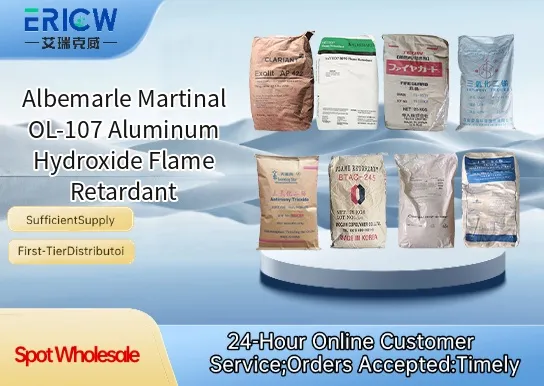
High-purity aluminum hydroxide with low sodium and iron content for enhanced polymer stability.
Optimized particle size distribution for improved dispersion and mechanical property retention in filled polymers.
Endothermic decomposition at ~180–200 °C, releasing water vapor to cool the substrate and dilute flammable gases.
Halogen-free formulation supporting UL 94 V-0 and other low-smoke, low-toxicity fire safety requirements.
Surface-treated grade offering superior compatibility with polyolefins, PVC, and thermoset resins.
Flame-retarded polypropylene (PP) and polyethylene (PE) for automotive interior components.
Cable jacketing and insulation compounds requiring low smoke and zero halogen compliance (LSZH).
Unsaturated polyester (UP) and vinyl ester composites used in building façades and transportation panels.
Flexible and rigid PVC formulations for wire & cable, flooring, and profile extrusions.
Engineering thermoplastics such as ABS and PC/ABS blends for electronic housings and appliance parts.
| Chemical Type | Aluminum hydroxide, Al(OH)₃ |
| Product Form | White, free-flowing powder |
| Appearance | Off-white to white granular powder |
| Primary Applications | Polyolefins, PVC, unsaturated polyesters, thermosets |
| Key Features | Halogen-free, low smoke, endothermic flame retardant |
| Decomposition Onset Temperature | Approx. 180–200 °C (TGA, 10 °C/min, air) |
| Bulk Density | ~0.7–0.9 g/cm³ |
| Surface Treatment | Organosilane-based, optimized for polyolefin compatibility |
Q1: What is the primary mechanism by which Martinal OL-107 provides flame retardancy?
A: Martinal OL-107 functions primarily through endothermic decomposition, absorbing heat and releasing water vapor upon heating. This cools the substrate, dilutes flammable gases, and forms a protective alumina-rich char layer that impedes further thermal degradation and oxygen diffusion.
Q2: Is Martinal OL-107 suitable for use in halogen-free flame-retarded polymer systems?
A: Yes — Martinal OL-107 is a halogen-free, inorganic flame retardant specifically designed for environmentally driven formulations. It is widely used in polyolefins, thermoplastic elastomers, and engineering plastics where regulatory compliance and low smoke/toxicity are priorities.
Q3: How does particle size distribution affect processing and performance in compounded systems?
A: Martinal OL-107 features a controlled, narrow particle size distribution optimized for good dispersion and minimal impact on melt viscosity. This supports efficient compounding, enhances mechanical property retention, and contributes to consistent flame retardant performance across production batches.
Q4: Can Martinal OL-107 be surface-treated, and how does that influence compatibility with polymers?
A: Yes — Martinal OL-107 is available with proprietary surface treatments tailored to improve hydrophobicity and interfacial adhesion in non-polar matrices such as polypropylene and polyethylene. Surface modification enhances dispersion stability, reduces agglomeration, and helps maintain tensile strength and impact resistance in the final compound.
Contact With Us:
E-mail: wangxingqiang@ericwchem.com
Have a Questions? Call Us:
Add:
Building A1, Jiete Industrial Park, Huangpu District, Guangzhou City, Guangdong Province, China