English
 Español
 tiếng việt
 русский
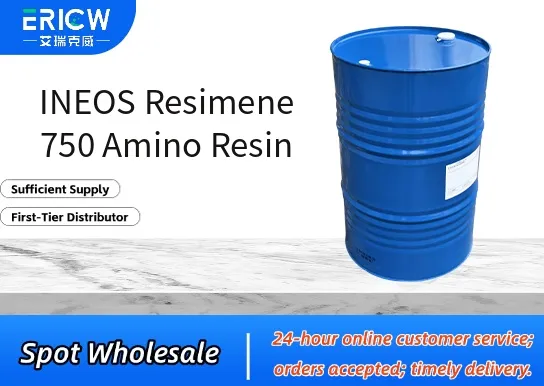
High reactivity with formaldehyde and melamine-based systems for rapid cure kinetics.
Excellent compatibility with polyester, alkyd, and acrylic resins in thermosetting coatings.
Superior gloss retention and color stability under UV exposure and thermal aging.
Low free formaldehyde content meeting stringent global regulatory requirements (e.g., REACH, EPA).
Consistent batch-to-batch performance ensured by INEOS’s controlled manufacturing process.
Automotive OEM and refinish topcoats requiring high durability and chip resistance.
Industrial coil coatings for pre-painted metal used in building and appliance sectors.
Can coatings for food and beverage containers demanding FDA-compliant curing performance.
General-purpose baking enamels for metal furniture, hardware, and agricultural equipment.
Electrical insulation varnishes for motors, transformers, and wire enamel systems.
| Chemical Type | Methanol-modified melamine-formaldehyde resin |
| Product Form | Clear to pale yellow liquid |
| Appearance | Homogeneous, low-viscosity solution |
| Solvent Content | Approx. 65–70% methanol |
| Non-Volatile Content (105°C, 30 min) | 28–32% w/w |
| Acid Number | < 5 mg KOH/g |
| Viscosity (25°C, Brookfield RV) | 50–120 cP |
| Storage Stability | 6 months at 20–25°C in sealed container |
Q1: What is the primary function of Resimene 750 in coating formulations?
A: Resimene 750 functions as a highly reactive amino crosslinker, primarily used to enhance cure speed, hardness, chemical resistance, and durability in thermosetting solvent-based and high-solids coatings—especially in automotive OEM and industrial maintenance applications.
Q2: Is Resimene 750 compatible with common hydroxyl-functional resins?
A: Yes, Resimene 750 exhibits excellent compatibility and reactivity with hydroxyl-terminated acrylics, polyesters, and alkyds. Its balanced functionality and low volatility support efficient coalescence and uniform network formation during thermal cure.
Q3: How should Resimene 750 be stored and handled to maintain stability?
A: Store in tightly sealed containers at temperatures between 10 °C and 30 °C, away from moisture, strong acids, and excessive heat. Prolonged exposure to humidity or elevated temperatures may lead to premature self-condensation or viscosity increase.
Q4: Does Resimene 750 require acid catalysts for optimal performance?
A: While it cures effectively under standard baking conditions (e.g., 140–160 °C), the use of weak organic acid catalysts—such as p-toluenesulfonic acid or blocked catalysts—can improve through-cure, reduce bake time, and broaden the processing window in demanding applications.
Q5: What are typical dosage levels when using Resimene 750 in a coating system?
A: Dosage depends on formulation requirements and desired film properties, but Resimene 750 is typically used at low concentrations—generally ranging from 0.1% to 2% by weight relative to total non-volatile content—to achieve full crosslink density without compromising flow or appearance.
Contact With Us:
E-mail: wangxingqiang@ericwchem.com
Have a Questions? Call Us:
Add:
Building A1, Jiete Industrial Park, Huangpu District, Guangzhou City, Guangdong Province, China