English
 Español
 tiếng việt
 русский
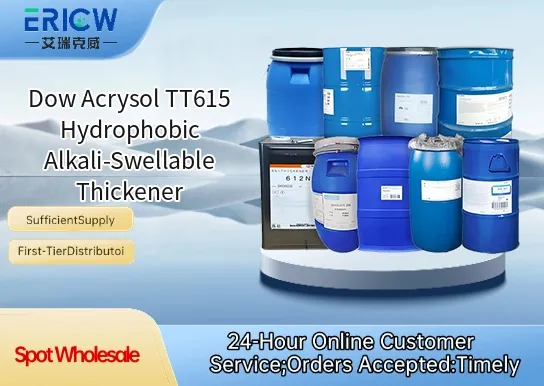
Delivers high-shear viscosity and excellent sag resistance in architectural and industrial coatings.
Provides outstanding rheology control with minimal impact on gloss and color development.
Offers superior hydrophobic character, enhancing water resistance and reducing sensitivity to electrolytes.
Enables efficient thickening upon alkaline activation, ensuring consistent performance across diverse formulation pH ranges.
Improves spatter resistance and brush/roller drag for enhanced application properties in waterborne paints.
Interior and exterior architectural flat and low-sheen latex paints.
Industrial maintenance coatings requiring robust film integrity and anti-sag performance.
Textured decorative coatings and elastomeric wall systems.
Waterborne wood finishes where balanced flow and leveling are critical.
Adhesives and construction sealants requiring controlled viscosity and stability.
| Chemical Type | Hydrophobically modified alkali-swellable emulsion (HASE) |
| Product Form | Aqueous dispersion |
| Appearance | Opaque white liquid |
| pH (as supplied) | 2.5–4.0 |
| Active Content (wt%) | 28–32% |
| Specific Gravity (25°C) | 1.02–1.06 g/cm³ |
| Viscosity (Brookfield RVT, Spindle #3, 20 rpm, 25°C) | 500–2,000 cP |
| Primary Applications | Waterborne architectural and industrial coatings |
Q1: How does TT615 differ from conventional associative thickeners?
A: TT615 is a hydrophobic alkali-swellable emulsion (HASE) thickener that provides rheology control primarily through pH-activated swelling and secondary hydrophobic association. Unlike purely associative (HEUR) thickeners, it offers enhanced water-thinning behavior, improved compatibility with high-electrolyte systems, and greater tolerance to surfactants commonly found in architectural coatings and industrial formulations.
Q2: What is the recommended neutralization method for optimal performance?
A: TT615 requires alkaline neutralization—typically with ammonia, AMP-95™, or sodium hydroxide—to fully develop viscosity. Neutralization is most effective when performed prior to addition to the final formulation, at pH ≥ 8.0. In-line neutralization during manufacturing is possible but should be followed by adequate mixing time to ensure complete swelling and network formation.
Q3: Is TT615 compatible with biocides and other common additives?
A: Yes, TT615 demonstrates good compatibility with a broad range of preservatives, defoamers, dispersants, and coalescing agents used in waterborne coatings. However, strong oxidizing biocides or highly acidic additives may interfere with its performance and should be evaluated in full formulation testing.
Q4: Can TT615 be used in low-VOC or zero-VOC formulations?
A: Yes, TT615 is formulated without volatile organic compounds and supports low-VOC and zero-VOC compliance when used as directed. Its high efficiency allows for lower dosage levels, contributing to reduced overall formulation VOC content without compromising rheological performance.
Contact With Us:
E-mail: wangxingqiang@ericwchem.com
Have a Questions? Call Us:
Add:
Building A1, Jiete Industrial Park, Huangpu District, Guangzhou City, Guangdong Province, China