English
 Español
 tiếng việt
 русский
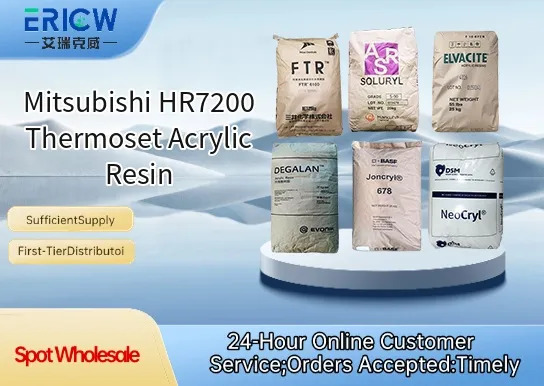
High crosslink density for exceptional thermal stability and chemical resistance.
Excellent UV resistance and long-term color retention in outdoor applications.
Low viscosity for superior flow and leveling in coating formulations.
Compatible with common amino crosslinkers (e.g., melamine-formaldehyde) for efficient cure at moderate temperatures.
Low VOC profile, supporting compliance with stringent environmental regulations.
Automotive OEM clearcoats and basecoats.
Industrial coil coatings for architectural and appliance metal substrates.
High-performance can coatings for food and beverage containers.
Powder coating binders requiring gloss retention and mechanical durability.
Refinish coatings for automotive and heavy equipment repair.
| Chemical Type | Thermosetting acrylic copolymer |
| Product Form | Liquid resin solution |
| Appearance | Clear, pale yellow to colorless liquid |
| Solids Content (wt%) | 55–60% (in xylene/butyl acetate blend) |
| Acid Value (mg KOH/g) | 8–12 |
| Weight Average Molecular Weight (Mw) | ~8,000–12,000 Da |
| Viscosity (mPa·s, 25°C) | 1,200–2,000 (at 60% solids) |
| Primary Applications | High-gloss, durable thermoset coatings requiring weatherability and chemical resistance |
Q1: What are the primary curing mechanisms for HR7200?
A: HR7200 is a thermoset acrylic resin designed for heat-activated crosslinking, typically via reaction with melamine-formaldehyde or urea-formaldehyde co-resins under elevated temperature. It may also be formulated with peroxide initiators for free-radical thermal cure in specific coating or molding applications.
Q2: Is HR7200 suitable for high-gloss, durable topcoats in automotive or industrial finishes?
A: Yes — HR7200 delivers excellent gloss retention, UV resistance, and mechanical toughness when properly formulated and cured, making it well-suited for premium topcoats requiring long-term weatherability and surface hardness in demanding industrial and OEM applications.
Q3: How does HR7200 compare to conventional thermoplastic acrylic resins in terms of performance?
A: Unlike thermoplastic acrylics, HR7200 forms an irreversible, three-dimensional network upon curing — resulting in significantly improved solvent resistance, thermal stability, and hardness. It maintains dimensional integrity at elevated service temperatures where thermoplastic versions would soften or deform.
Q4: Can HR7200 be used in powder coating formulations?
A: Yes — HR7200 is compatible with standard powder coating systems and offers good flow, leveling, and film formation when blended with appropriate crosslinkers and additives. Its molecular design supports low melt viscosity and efficient crosslink density development during thermal cure.
Contact With Us:
E-mail: wangxingqiang@ericwchem.com
Have a Questions? Call Us:
Add:
Building A1, Jiete Industrial Park, Huangpu District, Guangzhou City, Guangdong Province, China