English
 Español
 tiếng việt
 русский
High reactivity with hydroxyl-functional polyesters and acrylics in thermosetting powder coatings.
Enables excellent mechanical properties including hardness, flexibility, and impact resistance.
Low volatility and negligible emission of volatile organic compounds (VOCs) during curing.
Good storage stability as a free-flowing dry powder at ambient conditions.
Compatible with standard powder coating application equipment and curing cycles (e.g., 180–200 °C for 10–20 min).
Automotive exterior and interior trim coatings.
Architectural aluminum profiles and façade components.
Appliance housings for refrigerators, washing machines, and ovens.
General industrial metal finishing requiring durable, weather-resistant finishes.
Outdoor furniture and garden equipment coatings.
| Chemical Type | Bis(4-isocyanatocyclohexyl)methane (H12MDI)-based blocked polyisocyanate |
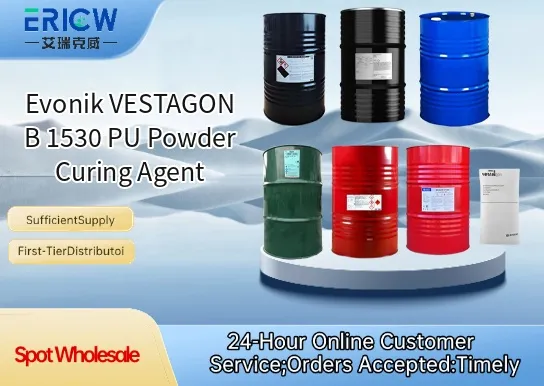
| Product Form | Free-flowing white to off-white crystalline powder |
| Appearance | Homogeneous granular powder, no visible lumps or dust agglomerates |
| Primary Applications | Curing agent for hydroxyl-functional polyester and acrylic powder coatings |
| Key Features | Blocked isocyanate technology; thermal deblocking above 140 °C |
| Benefits | Enhanced cure efficiency, improved film integrity, and reduced yellowing vs. aromatic systems |
| Storage Conditions | Keep in original sealed container at 5–25 °C, protect from moisture and direct sunlight |
| Shelf Life | Minimum 12 months under recommended storage conditions |
Q1: What is the primary function of VESTAGON B 1530 in thermosetting powder coatings?
A: VESTAGON B 1530 is a blocked polyisocyanate curing agent specifically designed for use in polyester–polyurethane (PU) hybrid powder coatings. It enables crosslinking at elevated temperatures after deblocking, delivering excellent gloss retention, mechanical durability, and chemical resistance in the cured film.
Q2: How does VESTAGON B 1530 differ from conventional aromatic or aliphatic isocyanate-based curing agents?
A: Unlike unblocked isocyanates, VESTAGON B 1530 features a thermally labile blocking group that prevents premature reaction during powder storage and extrusion. This provides superior shelf stability and processing safety while maintaining high reactivity upon cure—offering a balanced profile between storage stability and final film performance.
Q3: What is the typical recommended cure schedule when using VESTAGON B 1530?
A: Optimal cure is generally achieved at temperatures between 160 °C and 180 °C for 10–20 minutes, depending on substrate thickness and oven conditions. The exact profile should be validated in the end-user’s application to ensure full deblocking and crosslink density without yellowing or flow defects.
Q4: Is VESTAGON B 1530 compatible with standard polyester resins used in architectural and industrial powder coatings?
A: Yes—VESTAGON B 1530 is formulated for compatibility with hydroxyl-functional saturated polyesters commonly employed in high-performance decorative and protective powder systems. Compatibility and reactivity should be confirmed through small-scale formulation trials, especially with specialty or highly branched polyester grades.
Q5: How should VESTAGON B 1530 be handled and stored to maintain its performance?
A: Store in original sealed containers under dry, cool conditions (below 25 °C) and protect from moisture and direct sunlight. Avoid prolonged exposure to ambient humidity during handling, as residual moisture may affect blocking stability and lead to gelling or reduced pot life in premixes.
Contact With Us:
E-mail: wangxingqiang@ericwchem.com
Have a Questions? Call Us:
Add:
Building A1, Jiete Industrial Park, Huangpu District, Guangzhou City, Guangdong Province, China