English
 Español
 tiếng việt
 русский
Highly selective for hydrogenation of unsaturated aldehydes to unsaturated alcohols.
Thermally stable under industrial fixed-bed reactor conditions up to 180 °C.
Low metal leaching (<0.1 ppm Ni/Co in effluent) ensures product purity and catalyst longevity.
Engineered for excellent regenerability—maintains >95% activity after three regeneration cycles.
Sulfur-tolerant formulation enables robust operation with feedstocks containing trace sulfur impurities.
Production of citronellol and geraniol in fragrance intermediates synthesis.
Selective hydrogenation of cinnamaldehyde to cinnamyl alcohol for fine chemical manufacturing.
Conversion of crotonaldehyde to crotyl alcohol in pharmaceutical precursor routes.
Upgrading bio-based platform molecules such as furfural derivatives in sustainable chemistry processes.
Continuous-flow hydrogenation in modular and microreactor systems for on-demand specialty chemical synthesis.
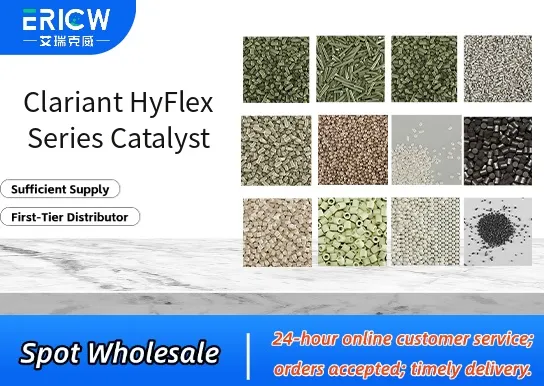
| Chemical Type | Ni–Co bimetallic supported on high-surface-area alumina |
| Product Form | Extruded cylindrical pellets (3 mm diameter × 3–5 mm length) |
| Appearance | Gray-black free-flowing granules |
| Primary Applications | Selective partial hydrogenation of α,β-unsaturated aldehydes |
| Key Features | High chemoselectivity, low operating pressure (1–10 bar H₂), water-tolerant |
| Benefits | Reduced downstream purification costs, extended catalyst lifetime, improved process safety |
| Storage Conditions | Store under inert atmosphere (N₂ or Ar) at ambient temperature; avoid moisture exposure |
| Handling Precautions | Use in well-ventilated areas; avoid inhalation of dust; refer to SDS for pyrophoric handling guidance |
Q1: What is the primary function of the Clariant HyFlex Series Catalyst in polymer processing?
A: The HyFlex Series Catalyst is designed to facilitate controlled crosslinking or curing reactions—particularly in peroxide-cured elastomers and thermoset systems—enhancing thermal stability, mechanical resilience, and process efficiency without compromising scorch safety.
Q2: Is the HyFlex Series compatible with food-contact or medical-grade polymer formulations?
A: While HyFlex catalysts are engineered for high purity and low volatility, regulatory compliance for food-contact or medical applications depends on final formulation validation and end-use conditions. Customers are advised to conduct full regulatory assessment—including extractables testing—within their specific system.
Q3: How does the HyFlex Series differ from conventional organic peroxide initiators?
A: Unlike traditional peroxides, HyFlex catalysts operate via a non-radical, metal-mediated mechanism—offering improved temperature selectivity, reduced odor and volatile byproducts, and greater tolerance to common polymer additives such as antioxidants and fillers.
Q4: What handling precautions should be observed during storage and dosing?
A: Store in original sealed containers under cool, dry conditions away from direct sunlight and strong oxidizers. Due to its catalytic activity, avoid prolonged contact with metals such as copper or brass during handling; stainless steel or polymeric equipment is recommended for transfer and dispersion.
Contact With Us:
E-mail: wangxingqiang@ericwchem.com
Have a Questions? Call Us:
Add:
Building A1, Jiete Industrial Park, Huangpu District, Guangzhou City, Guangdong Province, China