English
 Español
 tiếng việt
 русский
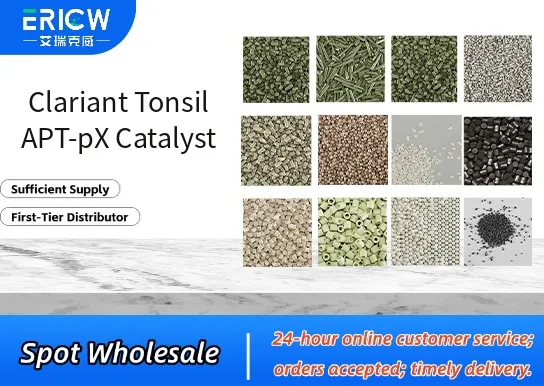
Highly selective acid catalyst for para-xylene (p-Xylene) isomerization and transalkylation reactions.
Thermally stable, low-dust granular form ensuring consistent handling and reactor bed integrity.
Optimized surface acidity and pore structure for enhanced catalyst lifetime and reduced coking.
Low sodium content (< 0.05 wt%) to minimize undesired side reactions and maintain high aromatic yield.
Designed for fixed-bed continuous operation in industrial-scale aromatic production units.
Isomerization of mixed xylenes to maximize para-xylene yield in petrochemical aromatics complexes.
Transalkylation of toluene and C9+ aromatics with benzene or xylene streams to boost p-xylene production.
Integration into integrated aromatics extraction and conversion units (e.g., Parex + Isomar®-type processes).
Upgrading of reformate-derived aromatic cuts in refineries seeking higher-value p-xylene output.
Use in licensed technology units requiring high-selectivity, sulfur-tolerant solid acid catalysts.
| Chemical Type | Modified aluminosilicate (acidic zeolite-based) |
| Product Form | Granules (cylindrical, 1.6–2.0 mm diameter) |
| Appearance | White to light beige free-flowing granules |
| Primary Applications | p-Xylene isomerization and aromatic transalkylation |
| Key Features | High para-selectivity, thermal stability up to 520 °C, low attrition |
| Benefits | Extended cycle length, reduced hydrogen consumption, improved product purity |
| Storage Conditions | Store in dry, ventilated area; protect from moisture and direct sunlight |
| Handling Precautions | Use dust mask and gloves; avoid inhalation of fine particles |
Q1: What is the primary function of Tonsil APT-pX in polymer processing?
A: Tonsil APT-pX is a highly activated, acid-treated bentonite-based catalyst designed to promote controlled crosslinking and condensation reactions—particularly in silicone rubber and certain thermoset systems—enhancing cure efficiency and final mechanical performance.
Q2: Is Tonsil APT-pX compatible with platinum-catalyzed silicone formulations?
A: Yes, Tonsil APT-pX is formulated to be compatible with platinum-catalyzed silicone systems and does not typically interfere with hydrosilylation kinetics. However, compatibility should be verified under actual processing conditions due to potential interactions with specific inhibitors or fillers.
Q3: How should Tonsil APT-pX be incorporated into a formulation?
A: It is typically added during the high-shear mixing stage, either pre-dispersed in a carrier fluid or dry-blended with fillers. Uniform dispersion is critical to ensure consistent catalytic activity and avoid localized over-cure.
Q4: Does Tonsil APT-pX require activation or pre-treatment before use?
A: No, Tonsil APT-pX is supplied in its fully activated form and does not require thermal or chemical activation prior to incorporation. Storage under dry, cool conditions is recommended to maintain optimal reactivity.
Q5: Can Tonsil APT-pX be used in food-contact or medical-grade silicone applications?
A: While Tonsil APT-pX is based on purified natural clay, its suitability for regulated applications depends on full system validation—including extractables profiling and end-use compliance testing. Clariant recommends consultation with regulatory specialists and thorough qualification per intended application requirements.
Contact With Us:
E-mail: wangxingqiang@ericwchem.com
Have a Questions? Call Us:
Add:
Building A1, Jiete Industrial Park, Huangpu District, Guangzhou City, Guangdong Province, China