English
 Español
 tiếng việt
 русский
Excellent transparency and UV resistance for long-term optical clarity.
High melt flow index enabling efficient extrusion and injection molding processing.
Good impact strength and dimensional stability across a wide temperature range.
Low moisture absorption, minimizing post-molding warpage and haze development.
Compatible with common plastic additives including UV stabilizers and flame retardants.
Automotive interior trim components requiring high-gloss, scratch-resistant surfaces.
LED light guides and diffuser plates in lighting fixtures.
Medical device housings where biocompatibility support and sterilization resistance are needed.
Consumer electronics front panels and decorative overlays.
Architectural glazing elements for signage and interior partitions.
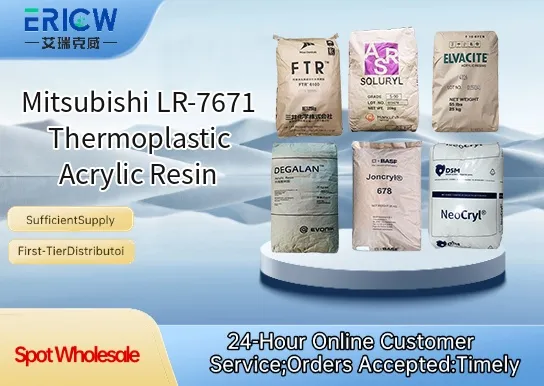
| Chemical Type | Poly(methyl methacrylate) (PMMA)-based thermoplastic acrylic resin |
| Product Form | Pellets |
| Appearance | Translucent, free-flowing granules |
| Melt Flow Index (230°C/3.8 kg) | 8–12 g/10 min |
| Density (23°C) | 1.19–1.21 g/cm³ |
| Transmittance (3 mm thickness) | ≥92% at 550 nm |
| Heat Deflection Temperature (1.82 MPa) | 102–106°C |
| Primary Applications | Optical components, decorative parts, functional housings |
Q1: What are the primary application areas for LR-7671?
A: LR-7671 is widely used in high-performance thermoplastic coatings and overprint varnishes, particularly where excellent clarity, gloss retention, and resistance to yellowing under UV exposure are required. It is commonly incorporated into packaging inks, decorative laminates, and protective topcoats for rigid substrates such as PET, PS, and ABS.
Q2: How does LR-7671 compare to other thermoplastic acrylic resins in terms of film-forming and solubility?
A: LR-7671 offers balanced solubility in common organic solvent blends—including esters, ketones, and aromatic hydrocarbons—enabling formulation flexibility without requiring aggressive solvents. Its molecular architecture supports good film formation at ambient temperatures and delivers cohesive, non-tacky films with strong substrate adhesion on both polar and moderately non-polar surfaces.
Q3: Is LR-7671 suitable for food-contact applications?
A: LR-7671 is designed for industrial and decorative applications, not for direct or indirect food contact unless explicitly validated and approved by the end-user’s regulatory team. Formulators should conduct full migration and compliance assessments based on their specific end-use conditions and applicable regional requirements.
Q4: What is the recommended handling and storage guidance for LR-7671?
A: Store LR-7671 in its original sealed container in a cool, dry, and well-ventilated area, away from direct sunlight and heat sources. Avoid prolonged exposure to moisture or extreme temperature fluctuations. Under these conditions, shelf life typically exceeds 12 months from date of manufacture.
Contact With Us:
E-mail: wangxingqiang@ericwchem.com
Have a Questions? Call Us:
Add:
Building A1, Jiete Industrial Park, Huangpu District, Guangzhou City, Guangdong Province, China