English
 Español
 tiếng việt
 русский
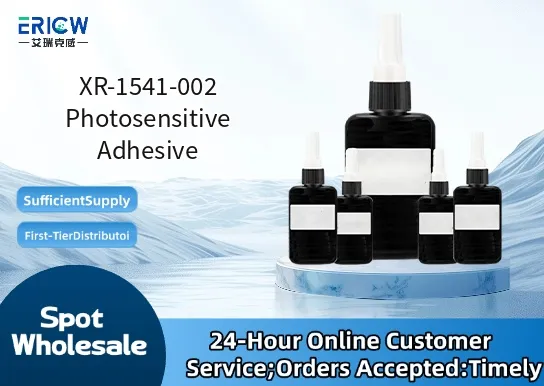
High-resolution patterning capability with <10 µm feature definition under standard UV exposure (i-line, 365 nm).
Excellent adhesion to silicon, glass, and metal substrates without primers.
Low outgassing profile suitable for vacuum-compatible microfabrication environments.
Thermally stable up to 180 °C post-cure, retaining dimensional integrity.
Water-developable formulation — eliminates need for hazardous organic solvents.
MEMS packaging and cavity sealing in pressure sensors and accelerometers.
Temporary bonding/debonding layers for silicon carrier wafer processing.
Photolithographic patterning of microfluidic channel structures on PMMA and COP substrates.
Dielectric isolation layers in RF and mmWave IC assembly.
Stencil-based adhesive transfer for precision die attach in advanced heterogeneous integration.
| Chemical Type | Acrylated epoxy resin with photoinitiator system |
| Product Form | Viscous liquid (non-volatile, solvent-free) |
| Appearance | Amber-transparent, low haze |
| Viscosity (25 °C) | 8,500–9,200 cP (Brookfield RV, spindle #3, 10 rpm) |
| Primary Applications | Photo-patternable temporary bonding & permanent encapsulation |
| Key Features | UV-curable, thermal reworkable below 220 °C, non-corrosive |
| Benefits | Enables high-yield debonding, minimal residue, compatible with automated dispense |
| Regulatory Compliance | REACH SVHC-free; RoHS 2015/863 compliant; no intentionally added PFAS |
| Common Compatible Systems | Suitability |
| EVG® 501/510/520HE Bonding Tools | Highly Recommended – Optimized process recipes available |
| Karl Suss MA8 / SB8 Mask Aligners | Recommended – Requires minor focus/exposure calibration |
| DISCO DFP8760 Dicing Tape Platform | Suitable – Validated for backgrind support with controlled release |
| Screen Printing (stainless steel mesh, 120–200 µm) | Recommended – Excellent paste rheology and edge definition |
Q1: What is the CAS Registry Number for XR-1541-002?
A: The CAS number is 2272124-89-7. This identifier applies to the fully formulated product as supplied.
Q2: What is the recommended coating thickness and UV exposure dose for full cure?
A: Spin-coated films (5–15 µm) require 300–500 mJ/cm² at 365 nm (i-line); spray- or screen-coated layers (20–40 µm) require 700–1,000 mJ/cm². Post-exposure bake (90 °C, 3 min) enhances crosslink density.
Q3: How does XR-1541-002 compare to conventional B-stage epoxies in thermal debonding performance?
A: Unlike B-stage epoxies, XR-1541-002 exhibits reversible thermoplastic behavior below 220 °C, enabling clean, low-residue debonding via controlled thermal ramp (≤3 °C/min) without mechanical stress or plasma assistance.
Q4: Is XR-1541-002 compliant with food-contact or medical device regulations?
A: It is not certified for direct food contact or implantable medical use. However, it meets ISO 10993-5 (cytotoxicity) and USP <87> extractables testing for short-term external device manufacturing support applications.
Q5: Are there documented migration or leachables data under accelerated aging conditions?
A: Yes — GC-MS/IC analysis per ASTM F2180 shows <0.5 ppm total organic extractables after 168 h at 60 °C in 50% ethanol/water, confirming suitability for high-reliability microelectronics packaging.
Contact With Us:
E-mail: wangxingqiang@ericwchem.com
Have a Questions? Call Us:
Add:
Building A1, Jiete Industrial Park, Huangpu District, Guangzhou City, Guangdong Province, China