English
 Español
 tiếng việt
 русский
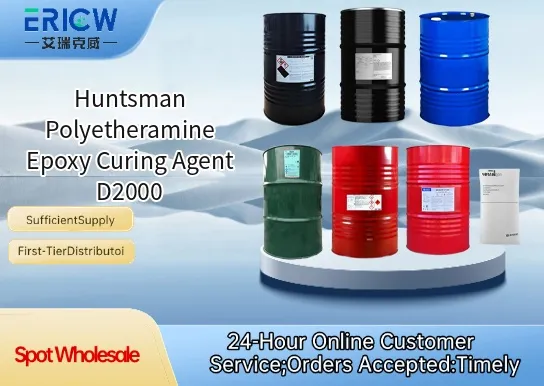
Extended pot life for improved processing window in large-scale composite manufacturing.
Low viscosity enables excellent wet-out of fibers and efficient resin infusion.
Excellent toughness and impact resistance in cured epoxy systems.
Good chemical resistance, particularly to alkalis and solvents.
Compatible with standard epoxy resins without requiring additional accelerators.
Wind turbine blade structural adhesives and matrix resins.
High-performance composite tooling and molds.
Marine structural laminates and repair systems.
Aerospace interior components requiring low VOC and flame-retardant formulations.
Industrial flooring and protective coatings for concrete substrates.
| Chemical Type | Polyetheramine (tertiary amine-terminated) |
| Product Form | Liquid |
| Appearance | Clear, pale yellow liquid |
| Primary Applications | Epoxy composites, structural adhesives, high-performance coatings |
| Key Features | Low viscosity, extended working time, high toughness |
| Benefits | Improved fiber impregnation, reduced void content, enhanced mechanical performance |
| Storage Stability | Stable under dry, cool conditions (≤30°C) for ≥12 months |
| Reactivity Profile | Medium reactivity; cures at ambient to elevated temperatures (20–80°C) |
Q1: What are the key performance advantages of D2000 compared to conventional amine curing agents?
A: D2000 offers significantly reduced volatility and improved handling safety due to its low vapor pressure and non-crystalline liquid form. It provides excellent flexibility, impact resistance, and low-temperature cure capability in epoxy systems, while maintaining good chemical resistance and adhesion to diverse substrates.
Q2: Is D2000 suitable for use in high-performance composite applications, such as wind blade manufacturing or aerospace tooling?
A: Yes — D2000 is widely used in structural composites where extended pot life, low exotherm, and high toughness are required. Its polyetheramine backbone contributes to superior interlaminar shear strength and fatigue resistance, making it well-suited for infusion and prepreg processes in demanding composite applications.
Q3: How does D2000 affect the processing window and gel time of epoxy resins?
A: D2000 extends working time relative to aliphatic amines while enabling full cure at ambient or moderately elevated temperatures. Gel time is formulation-dependent but generally provides a practical balance between handling time and throughput — especially beneficial in large-part casting or coating applications requiring uniform flow and minimal entrapped air.
Q4: Can D2000 be blended with other curing agents to tailor cure profile or final properties?
A: Yes — D2000 is compatible with many epoxy curing agents, including other polyetheramines, aromatic amines, and anhydrides. Blending allows formulators to fine-tune reactivity, flexibility, Tg, and chemical resistance without compromising compatibility or phase stability in the cured network.
Contact With Us:
E-mail: wangxingqiang@ericwchem.com
Have a Questions? Call Us:
Add:
Building A1, Jiete Industrial Park, Huangpu District, Guangzhou City, Guangdong Province, China