English
 Español
 tiếng việt
 русский
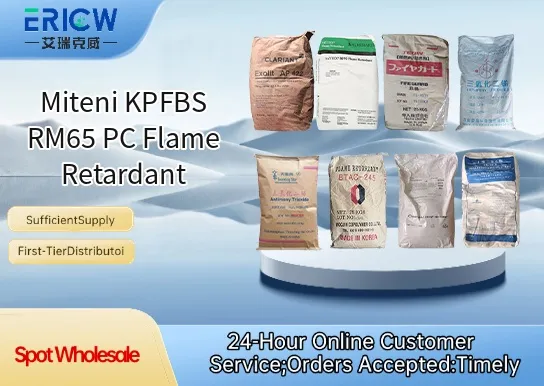
High-efficiency brominated flame retardant specifically formulated for polycarbonate (PC) and PC-based blends.
Excellent thermal stability up to 300°C, minimizing degradation during high-temperature processing such as injection molding.
Good compatibility with PC resins, ensuring uniform dispersion and minimal impact on mechanical properties like impact strength and clarity.
Meets stringent UL 94 V-0 rating at 1.6 mm thickness in standard PC formulations.
Low volatility and low migration tendency, supporting long-term flame-retardant performance and regulatory compliance.
Electrical and electronic enclosures requiring UL-certified flame resistance.
LED lighting housings and lens components where optical clarity and fire safety are critical.
Automotive interior trim parts including control panels and sensor housings.
Medical device casings subject to IEC 60601-1 flammability requirements.
Public transportation interior components complying with EN 45545-2 R22/R23 standards.
| Chemical Type | Polybrominated diphenyl ether (PBDE-free), brominated aromatic compound |
| Product Form | Powder |
| Appearance | White to off-white free-flowing powder |
| Primary Applications | Flame retardancy for polycarbonate and PC/ABS blends |
| Key Features | UL 94 V-0 compliant, heat stable, low blooming |
| Benefits | Maintains PC transparency and impact performance; suitable for thin-wall applications |
| Recommended Loading Range | 8–12 wt% in standard PC (varies by formulation) |
| Storage Conditions | Store in dry, cool, well-ventilated area; avoid moisture exposure |
Q1: What is the primary polymer compatibility of Miteni KPFBS RM65?
A: Miteni KPFBS RM65 is specifically engineered for use in polycarbonate (PC) and PC-based blends, offering excellent dispersion and thermal stability during melt processing without compromising mechanical or optical properties.
Q2: How does RM65 achieve flame retardancy without halogenated chemistry?
A: RM65 is a phosphorus-based flame retardant that functions primarily through condensed-phase action—promoting char formation and reducing fuel release during combustion—making it suitable for halogen-free flame-retardant PC formulations.
Q3: Is RM65 suitable for applications requiring high transparency or surface aesthetics?
A: Yes—RM65 exhibits low volatility and high compatibility with PC, resulting in minimal haze development and retained clarity in thin-walled or optically demanding parts when properly compounded.
Q4: What processing conditions are recommended for optimal performance?
A: RM65 is designed for standard PC processing methods including injection molding and extrusion. It remains stable under typical PC melt temperatures (280–310 °C), though residence time should be minimized to preserve thermal integrity and avoid potential degradation.
Q5: How does RM65 affect the mechanical properties of PC?
A: When formulated at appropriate dosage levels, RM65 maintains good retention of PC’s impact strength and tensile modulus. Some reduction in elongation at break may occur depending on loading level and base resin grade, but overall balance of flame retardancy and mechanical performance is well-established in commercial applications.
Contact With Us:
E-mail: wangxingqiang@ericwchem.com
Have a Questions? Call Us:
Add:
Building A1, Jiete Industrial Park, Huangpu District, Guangzhou City, Guangdong Province, China