English
 Español
 tiếng việt
 русский
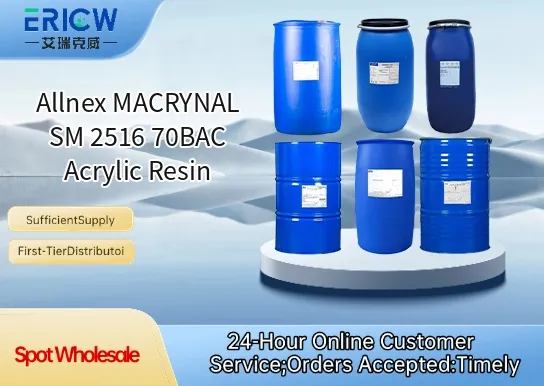
High-solids, solvent-borne acrylic resin offering excellent balance of hardness and flexibility.
Designed for superior gloss retention and UV resistance in demanding exterior coatings.
Provides good compatibility with common crosslinkers including melamine formaldehyde resins.
Delivers low viscosity at high solids content, supporting efficient application and film formation.
Exhibits excellent color stability and clarity, ideal for clearcoats and pigmented topcoats.
Automotive OEM and refinish clearcoats.
Industrial maintenance coatings for metal substrates.
General-purpose high-performance decorative topcoats.
Plastic coatings requiring adhesion and weatherability.
Architectural metal cladding and facade coatings.
| Chemical Type | Solvent-borne acrylic copolymer |
| Product Form | Liquid resin solution |
| Appearance | Clear, pale yellow liquid |
| Solids Content (wt%) | 70 ± 1 % |
| Viscosity (DIN 4, 23°C) | 80–120 s |
| Specific Gravity (23°C) | ~0.95–0.98 g/cm³ |
| Solvent System | Aromatic hydrocarbons / ester blend |
| Primary Applications | High-gloss, weather-resistant topcoats |
Q1: What is the primary function of MACRYNAL SM 2516 70BAC in coating formulations?
A: MACRYNAL SM 2516 70BAC is a solvent-based acrylic resin designed primarily as a rheology modifier and matting agent in high-performance industrial coatings. It helps control flow, enhance anti-settling properties, and contribute to uniform surface texture—especially in low-gloss or satin finishes.
Q2: Is this resin compatible with common crosslinkers used in thermosetting systems?
A: Yes, MACRYNAL SM 2516 70BAC exhibits good compatibility with standard amino resins (e.g., melamine-formaldehyde) and polyisocyanate hardeners in baked or ambient-cure systems. Compatibility should be verified experimentally within the final formulation due to sensitivity to solvent balance and acid value interactions.
Q3: How does this resin affect film formation and gloss development?
A: As a structured acrylic resin with controlled particle morphology, it promotes micro-roughness during film formation, leading to consistent matte or semi-matte appearance without compromising substrate coverage or mechanical integrity. Gloss reduction is achieved through physical surface modulation rather than pigment-dependent mechanisms.
Q4: What solvents are recommended for optimal dispersion and stability?
A: The resin is typically supplied pre-dissolved in aromatic hydrocarbons (e.g., xylene, Solvesso™ types) and shows good stability in blends containing esters (e.g., butyl acetate) and ketones (e.g., MEK). Avoid highly polar protic solvents such as alcohols, which may induce instability or viscosity drift.
Q5: Can MACRYNAL SM 2516 70BAC be used in food-contact compliant coatings?
A: While the base polymer chemistry is acrylic and inherently low in extractables, MACRYNAL SM 2516 70BAC is not pre-qualified for food-contact applications. Any use in such systems requires full regulatory assessment—including evaluation of the complete cured formulation—by the end-user’s compliance team.
Contact With Us:
E-mail: wangxingqiang@ericwchem.com
Have a Questions? Call Us:
Add:
Building A1, Jiete Industrial Park, Huangpu District, Guangzhou City, Guangdong Province, China