English
 Español
 tiếng việt
 русский
Excellent melt processability for high-speed extrusion and injection molding
Outstanding abrasion resistance and mechanical toughness at ambient and low temperatures
Good hydrolytic stability, suitable for humid or moisture-exposed environments
High clarity and gloss retention in thin-gauge applications
Compatible with common TPU processing equipment without requiring drying upgrades
Wire and cable jacketing for flexible data and power transmission
Medical tubing requiring kink resistance and biocompatibility support
Consumer electronics protective casings and soft-touch overmolds
Automotive interior trim components including seals and gaskets
Industrial hoses and pneumatic tubing demanding durability and flexibility
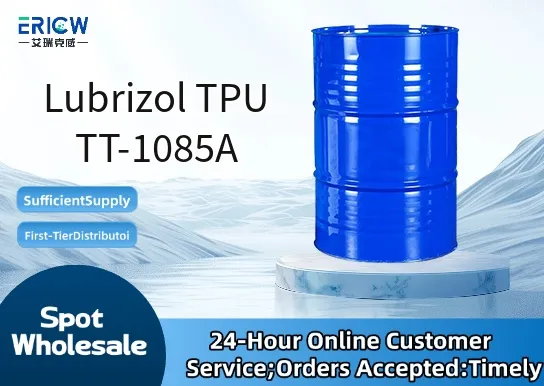
| Chemical Type | Thermoplastic Polyurethane (TPU), polyester-based |
| Product Form | Pellets |
| Appearance | Translucent, natural-colored pellets |
| Primary Applications | Extruded profiles, injection-molded parts, coextrusions |
| Key Features | High melt flow, low compression set, excellent dynamic flex life |
| Benefits | Reduced cycle times, improved surface finish, consistent part-to-part reproducibility |
| Processing Method | Injection molding, extrusion, blow molding |
| Recommended Drying | 80–90 °C for 2–4 hours prior to processing |
Q1: What is Lubrizol TPU TT-1085A primarily used for?
A: Lubrizol TPU TT-1085A is a thermoplastic polyurethane-based additive designed to enhance melt processability and improve surface finish in TPU compounds, particularly during extrusion and injection molding operations.
Q2: Is TT-1085A compatible with all TPU chemistries?
A: TT-1085A demonstrates broad compatibility with aromatic and aliphatic polyester- and polyether-based TPUs, though optimal performance should be verified through application-specific testing due to variations in molecular weight, hardness, and processing conditions.
Q3: How is TT-1085A typically incorporated into TPU formulations?
A: It is commonly added directly to the base TPU resin via dry blending or gravimetric feeding prior to extrusion, and is generally used at low concentrations—typically ranging from 0.1% to 2% by weight—depending on the desired balance of flow enhancement and mechanical property retention.
Q4: Does TT-1085A affect the final TPU’s physical properties?
A: When used within recommended dosage ranges, TT-1085A helps maintain key mechanical properties such as tensile strength and elongation while reducing melt viscosity; however, excessive loading may impact hardness or long-term thermal stability, so formulation optimization is advised.
Q5: Can TT-1085A be used in applications requiring regulatory compliance for food contact or medical devices?
A: TT-1085A is not pre-certified for food-contact or medical applications; its suitability must be evaluated case-by-case based on the full formulation, processing history, and applicable regional regulatory requirements.
Contact With Us:
E-mail: wangxingqiang@ericwchem.com
Have a Questions? Call Us:
Add:
Building A1, Jiete Industrial Park, Huangpu District, Guangzhou City, Guangdong Province, China