English
 Español
 tiếng việt
 русский
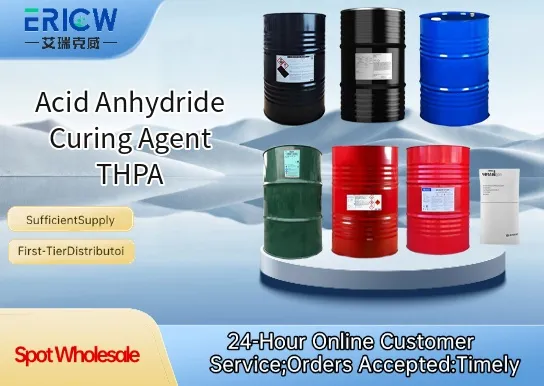
High thermal stability and excellent glass transition temperature (Tg) enhancement in cured epoxy systems.
Low volatility and low toxicity compared to traditional amine-based curing agents, improving workplace safety.
Good compatibility with standard bisphenol-A and bisphenol-F epoxy resins without requiring accelerators.
Slow-reacting nature enables extended pot life and improved processing control for thick-section casting and winding applications.
Delivers superior electrical insulation properties and moisture resistance in high-performance composites.
High-voltage electrical insulators and bushings for power transmission equipment.
Encapsulation and potting compounds for aerospace-grade electronic modules.
Winding varnishes and impregnating resins for high-efficiency motors and generators.
Structural composites in wind turbine blade root sections and marine components.
Advanced tooling and mold-making materials requiring dimensional stability under thermal cycling.
| Chemical Type | Tetrahydrophthalic anhydride (THPA) |
| Product Form | Crystalline solid |
| Appearance | White to off-white crystalline powder or flakes |
| Molecular Weight | 166.13 g/mol |
| Melting Point | 95–100 °C |
| Acid Value | 740–760 mg KOH/g |
| Moisture Content | ≤ 0.15 wt% |
| Key Features | Low exotherm, hydrolytic stability, non-corrosive to metals |
Q1: What is THPA and how does it function as a curing agent?
A: THPA (Tetrahydrophthalic Anhydride) is a cyclic acid anhydride widely used as a reactive curing agent for epoxy resins. It reacts with epoxy groups under elevated temperature to form ester linkages, delivering thermoset networks with good thermal stability, low viscosity, and favorable electrical insulation properties.
Q2: How should THPA be handled and stored to maintain its reactivity?
A: THPA is moisture-sensitive and should be stored in tightly sealed containers under dry, cool conditions—preferably below 25 °C and away from humidity and direct sunlight. Exposure to ambient moisture may lead to partial hydrolysis, reducing curing efficiency and potentially causing gelation or inconsistent performance.
Q3: What are typical processing conditions when using THPA with standard epoxy resins?
A: Curing typically requires an induction period followed by heat activation—commonly starting at 80–100 °C for initial reaction, then ramping to 120–160 °C for full network development. A catalytic co-agent (e.g., tertiary amines or imidazoles) is often added to enhance reactivity and broaden the processing window.
Q4: Is THPA compatible with flexible or modified epoxy systems?
A: Yes—THPA demonstrates broad compatibility with bisphenol-A, bisphenol-F, and novolac-based epoxies, as well as many reactive diluents and toughening modifiers. Its relatively low steric hindrance and balanced reactivity support formulations requiring improved impact resistance or reduced internal stress.
Contact With Us:
E-mail: wangxingqiang@ericwchem.com
Have a Questions? Call Us:
Add:
Building A1, Jiete Industrial Park, Huangpu District, Guangzhou City, Guangdong Province, China