English
 Español
 tiếng việt
 русский
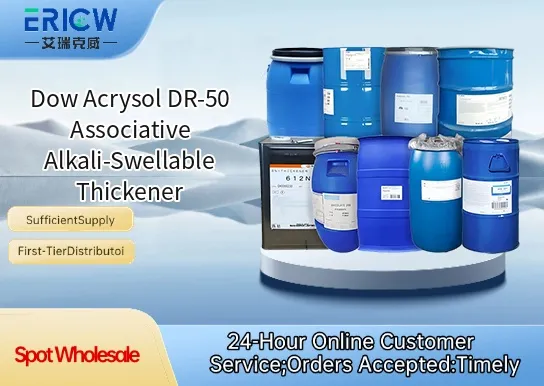
Delivers high mid-shear viscosity for excellent sag resistance and brush/roller application performance.
Provides superior flow and leveling control in waterborne architectural and industrial coatings.
Offers outstanding compatibility with common surfactants, co-thickeners, and pigment dispersants.
Delivers robust rheology retention after freeze-thaw cycling and long-term storage.
Enables efficient thickening at low dosage levels with minimal impact on color development and gloss.
Interior and exterior architectural flat and low-sheen latex paints.
Waterborne industrial maintenance coatings for metal and concrete substrates.
Acrylic-based primers and sealers requiring balanced viscosity and open time.
Textured decorative coatings and elastomeric wall systems.
Low-VOC and zero-VOC compliant coating formulations.
| Chemical Type | Associative alkali-swellable emulsion (ASE) |
| Product Form | Aqueous dispersion |
| Appearance | White to off-white opaque liquid |
| pH (as received) | 2.5 – 4.0 |
| Active Content (wt%) | 30.0 – 32.0% |
| Viscosity (Brookfield, Spindle #3, 20 rpm, 25°C) | 1,500 – 4,500 cP |
| Specific Gravity (25°C) | 1.02 – 1.06 g/cm³ |
| Freeze-Thaw Stability | Stable after 3 cycles (–18°C for 16 h / 25°C for 8 h) |
Q1: How does DR-50 differ from conventional non-associative alkali-swellable thickeners (ASE)?
A: DR-50 is an associative alkali-swellable thickener (A-ASE), meaning it contains hydrophobic groups that enable intermolecular association in addition to the typical acid–base swelling mechanism. This provides superior rheology control—especially enhanced high-shear viscosity recovery, better sag resistance, and improved leveling—compared to traditional non-associative ASE thickeners.
Q2: What pH range is required for optimal activation and viscosity development?
A: DR-50 requires alkaline conditions to fully ionize and swell; effective thickening typically begins above pH 7.5 and is most robust between pH 8.5 and 10.5. Viscosity development is progressive with increasing pH, but excessive alkalinity (e.g., >11.5) may compromise long-term stability or compatibility in some systems.
Q3: Can DR-50 be used in combination with other rheology modifiers, such as HEC or hydrophobically modified ethoxylated urethanes (HEUR)?
A: Yes, DR-50 is commonly blended with HEUR thickeners to achieve balanced low-, mid-, and high-shear viscosity profiles. It is generally compatible with many cellulose ethers (e.g., HEC), though synergy or antagonism depends on formulation specifics—including surfactant package, co-solvents, and ionic strength—so lab-scale evaluation is recommended before full-scale implementation.
Q4: How should DR-50 be incorporated into a water-based formulation?
A: DR-50 is supplied as a liquid latex and is typically added during the let-down stage, after primary emulsion polymer particles are formed and pH has been adjusted to ≥8.0. For best dispersion and viscosity development, add slowly with moderate agitation and allow sufficient time (e.g., 15–30 minutes) for full swelling and associative network formation before final adjustments.
Contact With Us:
E-mail: wangxingqiang@ericwchem.com
Have a Questions? Call Us:
Add:
Building A1, Jiete Industrial Park, Huangpu District, Guangzhou City, Guangdong Province, China