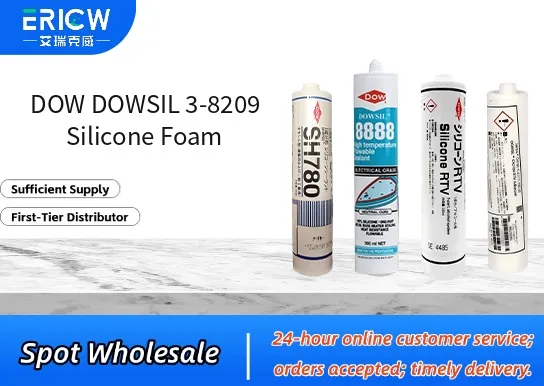
Features Of DOW DOWSIL 3-8209 Silicone Foam
Soft, compressible silicone foam with excellent resilience and long-term compression set resistance.
Broad operating temperature range from –65 °C to +200 °C for reliable performance in extreme environments.
Naturally flame-retardant (UL 94 HF-1 rated) without halogenated additives.
Low outgassing and low ionic content — suitable for aerospace, medical, and high-purity electronics applications.
Easily die-cut, kiss-cut, or waterjet-cut; compatible with standard gasketing and assembly processes.
Typical Applications Of DOW DOWSIL 3-8209 Silicone Foam
Aerospace cabin sealing and thermal/acoustic insulation gaskets.
Medical device enclosures requiring biocompatibility and sterilization resistance.
EV battery module cushioning and fire barrier padding.
High-reliability electronics housings for EMI/RFI shielding interface seals.
LED lighting fixtures demanding long-life light-tight and environmental seals.
Specifications Of DOW DOWSIL 3-8209 Silicone Foam
| Chemical Type | Platinum-cured silicone elastomer foam |
| Product Form | Die-cut sheets, rolls, or custom gaskets (standard thicknesses: 1.5–10 mm) |
| Appearance | Uniform beige, closed-cell foam with smooth skin surfaces |
| Primary Applications | Sealing, cushioning, thermal management, and fire barrier solutions |
| Key Features | Flame retardant (UL 94 HF-1), low compression set, wide temperature stability |
| Benefits | Reduced assembly force, long-term seal integrity, halogen-free formulation |
| Compliance | Meets ASTM D1056, UL 94, and ISO 10993-5 (cytotoxicity tested) |
DOW DOWSIL 3-8209 Silicone Foam – Frequently Asked Questions (FAQ)
Q1: What is the primary function of DOWSIL 3-8209 in silicone foam formulations?
A: DOWSIL 3-8209 is a silicone-based foam control agent specifically designed to suppress and break foam during the mixing, processing, and curing stages of high-consistency and liquid silicone rubber (HCR/LSR) systems. It helps achieve uniform cell structure and surface finish in cured foam products.
Q2: Is DOWSIL 3-8209 compatible with platinum-cured and peroxide-cured silicone systems?
A: Yes, DOWSIL 3-8209 is formulated for broad compatibility across both platinum-catalyzed and peroxide-cured silicone elastomer systems, including those used in medical-grade and automotive foam applications. It does not interfere with cure kinetics or final mechanical properties when used at recommended levels.
Q3: How should DOWSIL 3-8209 be incorporated into a silicone compound?
A: It is typically added during the initial mixing stage—either directly to the base polymer or with fillers—under moderate shear. Pre-dispersion is not required, but thorough homogenization ensures optimal performance. Dosage depends on formulation viscosity, filler loading, and foaming tendency, and generally ranges from 0.1% to 2% by weight of the total compound.
Q4: Does DOWSIL 3-8209 affect the compression set or thermal stability of the final silicone foam?
A: When used within the recommended dosage range, DOWSIL 3-8209 does not negatively impact key performance attributes such as compression set resistance, thermal aging behavior, or long-term elasticity. Its inert silicone chemistry contributes to retention of the base polymer’s inherent stability.
 English
 Español
 tiếng việt
 русский