English
 Español
 tiếng việt
 русский
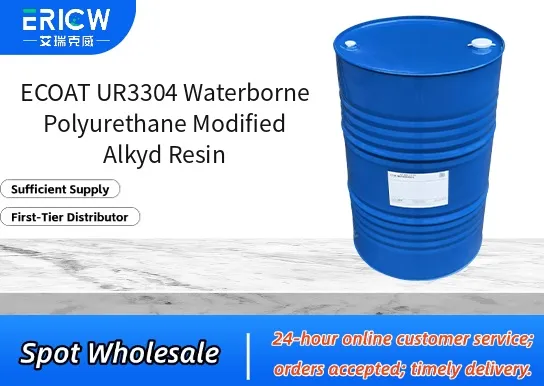
Waterborne formulation delivering low VOC emissions and compliance with stringent environmental regulations.
Enhanced mechanical durability and abrasion resistance due to polyurethane modification.
Excellent adhesion to diverse substrates including metal, wood, and primed plastics.
Good hydrolytic stability and shelf life exceeding 12 months at 5–30°C.
Compatible with common water-based crosslinkers (e.g., melamine formaldehyde and aziridine) for customizable cure profiles.
Architectural and industrial maintenance coatings for exterior metal structures.
Water-based wood finishes for interior furniture and cabinetry.
Coil coating topcoats requiring balanced flexibility and weather resistance.
Refinish coatings for agricultural and construction equipment.
Low-VOC OEM coatings for light-duty metal components in HVAC and appliance manufacturing.
| Chemical Type | Waterborne polyurethane-modified alkyd resin |
| Product Form | Aqueous dispersion |
| Appearance | Opaque off-white to pale yellow liquid |
| pH (25°C) | 7.8–8.5 |
| Solids Content (wt%) | 38–42% |
| Viscosity (Brookfield, LVT, #2 spindle, 60 rpm, 25°C) | 1,200–2,500 cP |
| Density (25°C) | 1.02–1.05 g/cm³ |
| Minimum Film Formation Temperature (MFFT) | ≥10°C |
Q1: What are the primary advantages of using ECOAT UR3304 over conventional solvent-based alkyds?
A: ECOAT UR3304 offers significantly reduced VOC content while retaining the familiar handling, film formation, and substrate adhesion characteristics of traditional alkyds. Its polyurethane modification enhances mechanical durability, chemical resistance, and gloss retention—without requiring major reformulation or process changes in waterborne coating systems.
Q2: Is ECOAT UR3304 compatible with common waterborne acrylic or polyester dispersions?
A: Yes—ECOAT UR3304 is designed for broad compatibility with standard anionic and non-ionic waterborne polymer dispersions, including acrylics and polyesters. It typically integrates smoothly without phase separation or viscosity instability, though compatibility should always be verified under actual formulation conditions and shear history.
Q3: How does ECOAT UR3304 contribute to film performance in low-bake or ambient-cure applications?
A: The resin’s hybrid architecture supports coalescence and crosslinking at lower temperatures by balancing hydrophilic functionality with reactive urethane moieties. This enables robust film development—even under ambient or mild thermal conditions—delivering improved hardness build, early water resistance, and reduced blocking tendency compared to unmodified alkyd emulsions.
Q4: Can ECOAT UR3304 be used in direct-to-metal (DTM) waterborne coatings?
A: Yes—it is frequently employed in DTM formulations where corrosion inhibition, adhesion to untreated or lightly pretreated steel and aluminum, and flexibility are required. Its modified backbone improves interfacial wetting and promotes cohesive strength, supporting performance in both interior and moderate exterior exposure environments.
Contact With Us:
E-mail: wangxingqiang@ericwchem.com
Have a Questions? Call Us:
Add:
Building A1, Jiete Industrial Park, Huangpu District, Guangzhou City, Guangdong Province, China