English
 Español
 tiếng việt
 русский
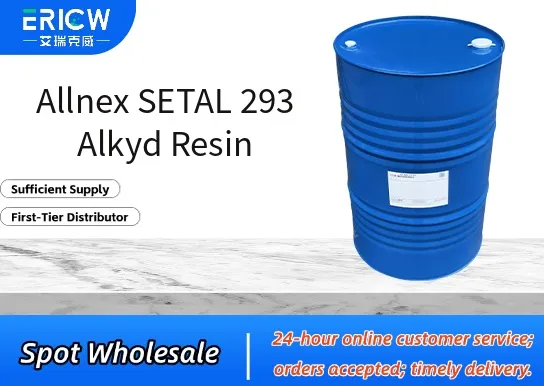
Medium-oil, cobalt-free alkyd resin designed for excellent through-dry and surface cure balance.
Offers superior gloss retention and weather resistance in exterior architectural coatings.
Compatible with a broad range of solvents, pigments, and co-resins including acrylics and melamines.
Delivers good flow, leveling, and brushability in solvent-borne decorative and protective formulations.
Formulated to meet stringent VOC regulations in major global markets without compromising performance.
Exterior wood stains and semi-transparent finishes.
Architectural trim and siding paints for residential and commercial use.
General-purpose maintenance coatings for metal and masonry substrates.
Industrial maintenance enamels requiring durable film formation and UV stability.
High-solids, low-VOC solvent-borne decorative topcoats.
| Chemical Type | Medium-oil alkyd resin (phthalic anhydride–based, soybean oil modified) |
| Product Form | Liquid |
| Appearance | Clear to pale yellow viscous liquid |
| Primary Applications | Exterior architectural coatings, maintenance enamels, wood finishes |
| Key Features | Cobalt-free, good through-dry, high gloss retention, UV-stable |
| Benefits | Reduced risk of premature oxidation, improved formulation stability, compliance with REACH & EPA guidelines |
| Solubility | Compatible with aromatic and aliphatic hydrocarbons, ketones, and esters |
| Storage Stability | Stable for ≥12 months in unopened original containers at 15–25°C |
Q1: What is the primary application area for SETAL 293?
A: SETAL 293 is a medium-oil, cobalt-free alkyd resin specifically designed for high-performance air-drying industrial maintenance and protective coatings, including general metal primers, undercoats, and mid-coats where good through-dry, sandability, and compatibility with nitrocellulose or acrylic topcoats are required.
Q2: Is SETAL 293 compatible with common crosslinkers used in two-component systems?
A: SETAL 293 is formulated as an air-drying alkyd and is not intended for use with external crosslinkers such as melamines or isocyanates. It relies on autoxidative curing and performs best in single-component formulations; blending with reactive resins may interfere with film formation and drying behavior.
Q3: How does SETAL 293 compare to cobalt-catalyzed alkyds in terms of drying performance?
A: As a cobalt-free alkyd, SETAL 293 delivers reliable surface dry and through-dry without heavy-metal catalysts, making it suitable for applications where cobalt restrictions apply. While initial surface dry may be slightly slower than cobalt-containing equivalents, its through-dry profile remains robust under typical ambient conditions.
Q4: Can SETAL 293 be thinned with standard organic solvents?
A: Yes — SETAL 293 exhibits good solubility in common aromatic and aliphatic hydrocarbon solvents, including xylene, mineral spirits, and high-flash naphthas. Solvent selection should consider VOC regulations and desired evaporation rate for the target application.
Q5: What types of pigments and additives is SETAL 293 typically formulated with?
A: SETAL 293 demonstrates broad compatibility with conventional inorganic pigments (e.g., iron oxides, titanium dioxide) and common coating additives such as rheology modifiers, defoamers, and wetting agents. Formulators should verify compatibility and dispersion stability during development, especially when using highly polar or reactive additives.
Contact With Us:
E-mail: wangxingqiang@ericwchem.com
Have a Questions? Call Us:
Add:
Building A1, Jiete Industrial Park, Huangpu District, Guangzhou City, Guangdong Province, China