English
 Español
 tiếng việt
 русский
Excellent abrasion resistance for demanding dynamic applications.
Outstanding low-temperature flexibility down to –30 °C.
Good hydrolytic stability suitable for humid and outdoor environments.
High melt processability with consistent rheology for extrusion and injection molding.
Compatible with common TPU processing equipment and standard drying protocols.
Automotive interior trim components including door panels and instrument bezels.
Industrial hoses and pneumatic tubing requiring flex fatigue resistance.
Protective overmolding for electronic connectors and handheld device housings.
Footwear midsoles and outsole compounds requiring rebound and durability.
Medical-grade non-implantable tubing and fluid handling components.
| Chemical Type | Thermoplastic Polyurethane (TPU), Polyester-based |
| Product Form | Pellets |
| Appearance | Off-white to light tan, free-flowing pellets |
| Primary Applications | Extrusion, injection molding, blow molding |
| Key Features | Abrasion resistance, low-temp flexibility, hydrolysis resistance |
| Benefits | Extended service life in cyclic loading, reduced part failure in cold climates |
| Drying Recommendation | 80–90 °C for 3–4 hours prior to processing |
| Processing Temperature Range | 180–220 °C (melt temperature) |
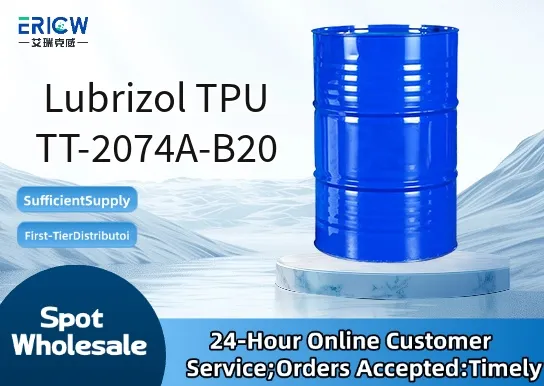
Q1: What is the primary function of Lubrizol TPU TT-2074A-B20 in thermoplastic polyurethane (TPU) formulations?
A: Lubrizol TPU TT-2074A-B20 is a high-performance processing aid and surface modifier designed to improve melt flow, reduce extrusion die buildup, and enhance surface gloss and slip characteristics in TPU compounds—without compromising mechanical integrity or thermal stability.
Q2: Is TT-2074A-B20 compatible with common TPU base resins, including polyester- and polyether-based grades?
A: Yes, TT-2074A-B20 demonstrates broad compatibility across major TPU chemistries, including aromatic and aliphatic polyester- and polyether-based TPUs. It disperses readily during standard compounding processes such as twin-screw extrusion.
Q3: How should TT-2074A-B20 be incorporated into TPU processing—masterbatch or direct addition?
A: It can be introduced either as a pre-dispersed masterbatch or via direct dry-blend addition prior to extrusion or injection molding. Direct addition is commonly used when precise dosing control and minimal formulation complexity are desired.
Q4: Does TT-2074A-B20 affect the long-term aging or UV resistance of finished TPU parts?
A: TT-2074A-B20 itself is not a UV stabilizer, but it does not negatively impact the performance of co-added UV absorbers or HALS stabilizers. Its non-volatile nature supports retention of surface properties during extended service life under typical indoor and moderate outdoor conditions.
Contact With Us:
E-mail: wangxingqiang@ericwchem.com
Have a Questions? Call Us:
Add:
Building A1, Jiete Industrial Park, Huangpu District, Guangzhou City, Guangdong Province, China