English
 Español
 tiếng việt
 русский
Excellent film clarity and gloss retention after curing.
Low VOC content (< 50 g/L), compliant with stringent environmental regulations.
Good hydrolytic stability and storage life of ≥12 months at 5–35 °C.
High mechanical strength with balanced flexibility and abrasion resistance.
Easy coalescence and smooth film formation without added co-solvents.
Water-based leather finishing topcoats for footwear and furniture.
High-performance coatings for flexible packaging laminates.
Industrial wood coatings requiring low-emission, durable finishes.
Textile and nonwoven fabric coatings for water repellency and hand feel enhancement.
Adhesive binders in automotive interior trim composites.
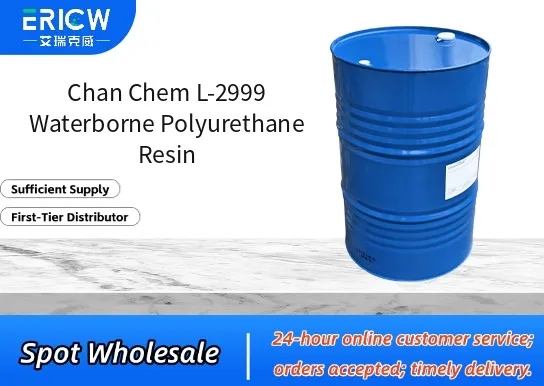
| Chemical Type | Aliphatic anionic waterborne polyurethane dispersion |
| Product Form | Liquid dispersion |
| Appearance | Translucent, slightly bluish milky liquid |
| Solids Content | 30 ± 1 wt% |
| pH | 7.8 – 8.4 |
| Viscosity (25 °C, Brookfield RVT, #2 spindle, 20 rpm) | 150 – 300 mPa·s |
| Particle Size (D50) | 45 – 65 nm |
| Minimum Film Formation Temperature (MFFT) | 12 – 15 °C |
Q1: What are the key advantages of L-2999 compared to solvent-based polyurethane resins?
A: L-2999 offers significantly reduced VOC content, improved workplace safety, and simplified regulatory compliance for coatings and adhesives. It delivers excellent film formation, flexibility, and abrasion resistance without requiring organic solvents, making it suitable for environmentally sensitive applications and indoor-use formulations.
Q2: Is L-2999 compatible with common waterborne acrylic or epoxy dispersions?
A: Yes, L-2999 is formulated for good compatibility with many waterborne acrylic emulsions and epoxy dispersions. Compatibility should be verified in the final formulation through stability testing, as performance may vary depending on pH, ionic strength, and surfactant systems used.
Q3: Can L-2999 be used in low-temperature curing applications?
A: L-2999 exhibits good coalescence and film formation at ambient temperatures, and can perform effectively in mild low-temperature conditions (e.g., down to 10–15 °C) when humidity and drying time are appropriately controlled. For consistent performance below 10 °C, formulation adjustments or mild thermal assistance may be beneficial.
Q4: How should L-2999 be stored and handled to maintain stability?
A: Store in tightly sealed containers at temperatures between 5 °C and 35 °C, away from freezing and direct sunlight. Avoid prolonged exposure to high shear or extreme pH shifts during handling. Prior to use, gently stir to ensure homogeneity without introducing excessive air.
Contact With Us:
E-mail: wangxingqiang@ericwchem.com
Have a Questions? Call Us:
Add:
Building A1, Jiete Industrial Park, Huangpu District, Guangzhou City, Guangdong Province, China