English
 Español
 tiếng việt
 русский
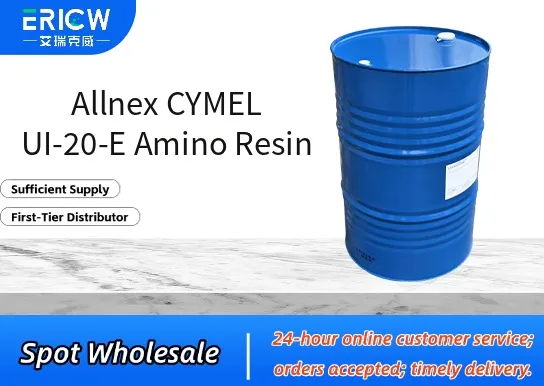
Highly reactive melamine-formaldehyde resin with low free formaldehyde content.
Excellent compatibility with acrylic, polyester, and alkyd resins in solventborne systems.
Provides outstanding hardness, chemical resistance, and gloss retention in cured films.
Enables fast cure at moderate baking temperatures (140–160 °C), improving production efficiency.
Low viscosity and good storage stability, facilitating easy handling and formulation.
Automotive OEM and refinish topcoats.
Industrial coil and appliance coatings.
General-purpose metal decorating and can coatings.
High-performance wood furniture and panel finishes.
| Chemical Type | Melamine-formaldehyde crosslinker |
| Product Form | Liquid |
| Appearance | Clear to slightly hazy, water-white liquid |
| Solvent Content | Approx. 70–75% (isobutanol/butanol blend) |
| Non-Volatile Content | 25–28% by weight |
| Viscosity (25 °C, Brookfield RV, spindle #3, 20 rpm) | 150–350 mPa·s |
| pH (10% solution in deionized water) | 7.5–9.0 |
| Free Formaldehyde | <0.3% w/w |
Q1: What is the primary function of CYMEL UI-20-E in coating formulations?
A: CYMEL UI-20-E functions as a low-viscosity, highly reactive melamine-formaldehyde crosslinker, designed to enhance cure speed, hardness, and chemical resistance in thermosetting solventborne and high-solids coatings—particularly where rapid ambient or low-bake performance is required.
Q2: How does CYMEL UI-20-E differ from conventional high-methylol melamine resins?
A: Unlike traditional high-methylol resins, CYMEL UI-20-E features a tailored degree of methylation and controlled volatility profile, offering improved compatibility with acrylic and polyester resins, reduced formaldehyde release during cure, and enhanced storage stability in acidic catalyzed systems.
Q3: Is CYMEL UI-20-E suitable for use in automotive refinish or industrial maintenance coatings?
A: Yes—it is widely used in demanding OEM and refinish applications where fast recoat times, excellent gloss retention, and resistance to solvents and abrasion are critical; formulation compatibility should be verified with the base resin system and catalyst selection.
Q4: What types of catalysts are typically recommended for optimal performance with CYMEL UI-20-E?
A: Acid catalysts such as p-toluenesulfonic acid (p-TSA), blocked acids, or weak organic acids are commonly employed; catalyst type and dosage depend on cure schedule, film thickness, and desired pot life—formulators generally adjust to balance reactivity and handling stability.
Contact With Us:
E-mail: wangxingqiang@ericwchem.com
Have a Questions? Call Us:
Add:
Building A1, Jiete Industrial Park, Huangpu District, Guangzhou City, Guangdong Province, China