English
 Español
 tiếng việt
 русский
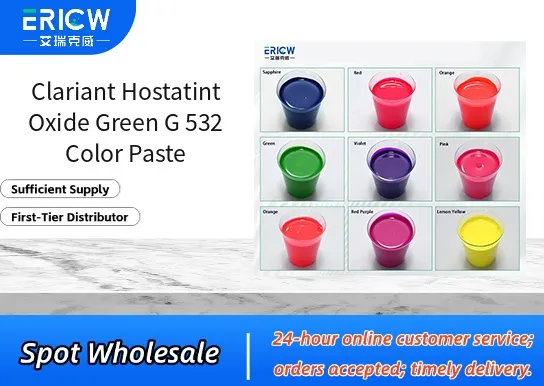
Highly concentrated inorganic oxide green pigment dispersion for efficient coloration.
Excellent thermal stability suitable for processing temperatures up to 280 °C.
Good lightfastness and weather resistance in demanding outdoor applications.
Optimized rheology for easy incorporation into polymer melts and masterbatch formulations.
Compliant with major global regulatory frameworks including EU REACH and US FDA 21 CFR for indirect food contact applications.
Polypropylene (PP) and polyethylene (PE) packaging films and containers.
Automotive interior components requiring long-term color stability.
Construction profiles and exterior cladding materials exposed to UV radiation.
Household appliances and durable goods housings.
Industrial technical parts where chemical and thermal resistance are critical.
| Chemical Type | Inorganic oxide green pigment (chromium oxide-based) dispersion |
| Product Form | High-viscosity paste |
| Appearance | Dark green, homogeneous paste |
| Primary Applications | Polyolefin masterbatches, engineering thermoplastics, extruded profiles |
| Key Features | Thermal stability, low migration, high tinctorial strength |
| Benefits | Consistent color development, minimal plate-out, excellent dispersion stability |
| Recommended Carrier | Polyolefin-compatible carrier system |
| Storage Conditions | Store in sealed containers at 10–30 °C; protect from freezing and direct sunlight |
Q1: What is the primary chemical composition of Hostatint Oxide Green G 532?
A: Hostatint Oxide Green G 532 is a pigment-based color paste formulated with inorganic oxide green pigments dispersed in a non-aqueous, solvent-free carrier system optimized for polymer compatibility and thermal stability.
Q2: Is this color paste suitable for food-contact plastics?
A: Hostatint Oxide Green G 532 is designed for use in plastics applications where regulatory compliance is required; however, final food-contact suitability depends on the complete formulation, processing conditions, and applicable regional regulations—users must conduct full regulatory assessment and validation.
Q3: Which polymers is this paste most commonly used with?
A: It demonstrates excellent compatibility with polyolefins (e.g., PP, PE), engineering thermoplastics (e.g., ABS, PS), and certain PVC formulations; performance may vary depending on resin grade and processing method.
Q4: How should this color paste be stored to maintain stability?
A: Store in original sealed containers at temperatures between 5 °C and 30 °C, away from direct sunlight and sources of heat or moisture; avoid freezing and prolonged exposure to elevated temperatures.
Q5: What is the typical dosage range when incorporating this paste into plastic compounds?
A: Dosage is formulation-dependent but generally ranges from 0.1% to 2% by weight, with optimal loading determined by target shade intensity, base resin transparency, and processing parameters.
Contact With Us:
E-mail: wangxingqiang@ericwchem.com
Have a Questions? Call Us:
Add:
Building A1, Jiete Industrial Park, Huangpu District, Guangzhou City, Guangdong Province, China