English
 Español
 tiếng việt
 русский
High chroma red shade with excellent lightfastness and weather resistance.
Outstanding thermal stability suitable for high-temperature processing up to 280 °C.
Good dispersibility in both polar and non-polar polymer matrices.
Low migration tendency, meeting stringent requirements for food-contact and toy applications.
Compliant with major global regulatory frameworks including EU REACH, US FDA 21 CFR §178.3297, and ISO 8124-3.
Polyolefin masterbatches (PP, PE) for automotive interior components.
Engineering plastics including ABS, PC, and PBT for consumer electronics housings.
Food-grade packaging films requiring FDA-compliant colorants.
Toys and childcare articles compliant with EN71-3 and ASTM F963.
Industrial coatings where long-term color retention under UV exposure is critical.
| Chemical Type | Benzimidazolone derivative |
| Product Form | Free-flowing powder |
| Appearance | Reddish-brown powder |
| Primary Applications | Polyolefins, engineering plastics, coatings, inks |
| Key Features | High heat stability, low volatility, excellent dispersion |
| Benefits | Consistent batch-to-batch color, minimal plate-out, reduced filtration pressure |
| Regulatory Status | REACH registered; FDA 21 CFR §178.3297 compliant |
| Density (g/cm³) | 1.55–1.65 |
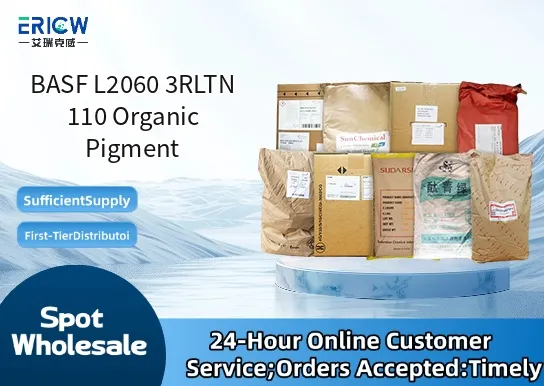
Q1: What is the primary chemical class and typical hue profile of BASF L2060 3RLTN 110?
A: BASF L2060 3RLTN 110 is a high-performance perylene-based organic pigment, offering strong red-shade violet to bluish-red coloration with excellent chroma and clean undertones. Its molecular structure contributes to inherent lightfastness and thermal stability.
Q2: Is this pigment suitable for use in food-contact plastics or other regulated polymer applications?
A: BASF L2060 3RLTN 110 is not pre-approved for direct food-contact applications under major global regulatory frameworks. It is intended for general-purpose industrial and decorative uses — including engineering thermoplastics, coatings, and masterbatches — where regulatory compliance is determined by the final formulation and processing conditions.
Q3: How does this pigment perform under high-temperature processing conditions, such as injection molding or extrusion?
A: This pigment demonstrates good thermal stability and is suitable for high-shear, high-temperature polymer processing, including polyolefins and engineering resins processed up to approximately 300 °C. Performance may vary depending on residence time, shear history, and resin compatibility.
Q4: What are the recommended dispersion methods to achieve optimal color development and consistency?
A: For best results, dispersion should be carried out using high-shear equipment such as twin-screw extruders or high-speed dispersers. Pre-wetting with compatible carrier resins or dispersing aids is recommended to ensure uniform distribution and minimize agglomerates, especially in demanding applications like thin films or transparent systems.
Q5: Can BASF L2060 3RLTN 110 be used in combination with other pigments or effect pigments?
A: Yes — it is commonly used in tinting systems and color blends, particularly with other high-stability organic pigments or inorganic oxides. Compatibility testing is advised when combining with effect pigments (e.g., aluminum flakes or pearlescents) to ensure no adverse interaction affecting gloss, orientation, or color strength.
Contact With Us:
E-mail: wangxingqiang@ericwchem.com
Have a Questions? Call Us:
Add:
Building A1, Jiete Industrial Park, Huangpu District, Guangzhou City, Guangdong Province, China