English
 Español
 tiếng việt
 русский
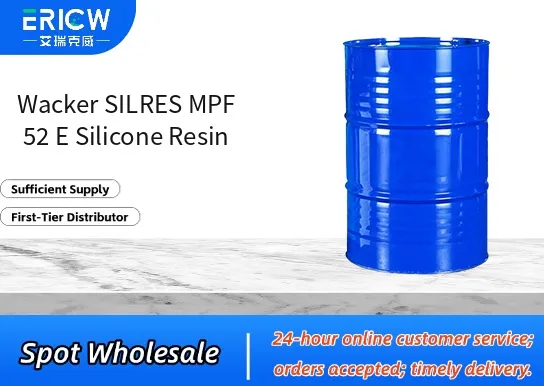
High thermal stability up to 250 °C for extended service life in demanding environments.
Excellent weather resistance and UV stability, maintaining performance under prolonged outdoor exposure.
Good compatibility with organic resins (e.g., acrylics, polyesters) enabling hybrid formulation development.
Low surface energy providing inherent water repellency and anti-soiling properties.
Solvent-based liquid format with controlled viscosity for easy integration into coating and impregnation processes.
High-performance protective coatings for façades and architectural concrete.
Water-repellent impregnations for natural stone, brick, and porous building materials.
Heat-resistant topcoats for industrial metal substrates and exhaust components.
Hybrid silicone-acrylic exterior wall paints requiring enhanced durability and breathability.
Functional additives in fire-retardant or anti-graffiti coating systems.
| Chemical Type | Methyl-phenyl silicone resin |
| Product Form | Liquid, solvent-based solution |
| Appearance | Clear, colorless to pale yellow liquid |
| Solvent | Xylene and/or aromatic hydrocarbon blend |
| Non-Volatile Content | Approx. 50 wt.% |
| Viscosity (25 °C) | Approx. 15–25 mPa·s (Brookfield LVT, spindle #3, 60 rpm) |
| Density (20 °C) | Approx. 0.92–0.94 g/cm³ |
| Flash Point (PMCC) | Approx. 35–40 °C |
Q1: What is the primary function of SILRES MPF 52 E in coating formulations?
A: SILRES MPF 52 E is a methyl-phenyl silicone resin designed to enhance surface hardness, mar resistance, and hydrophobicity in solvent-based and high-solids coatings. It functions as a crosslinking aid and film-modifier, improving durability without significantly compromising flexibility or adhesion.
Q2: Is SILRES MPF 52 E compatible with common organic resins such as acrylics, alkyds, and polyurethanes?
A: Yes, SILRES MPF 52 E exhibits good compatibility with a broad range of thermosetting and thermoplastic organic binders, including acrylics, alkyds, and polyurethane systems. Compatibility should be verified experimentally in the final formulation due to variations in solvent composition and molecular weight distribution.
Q3: How is SILRES MPF 52 E typically incorporated into a coating system?
A: It is generally added during the let-down stage under moderate agitation. Pre-dilution in a compatible solvent (e.g., xylene, aromatic naphtha, or acetate esters) is recommended to ensure uniform dispersion. Final dosage depends on formulation requirements but typically ranges from 0.1% to 2% by weight of total solids.
Q4: Does SILRES MPF 52 E require thermal curing to develop its full performance benefits?
A: While it contributes to ambient-cure performance, optimal hardness, chemical resistance, and hydrophobicity are achieved after thermal treatment—typically at temperatures between 120 °C and 180 °C for 15–30 minutes. The exact schedule depends on substrate, film thickness, and overall binder system.
Contact With Us:
E-mail: wangxingqiang@ericwchem.com
Have a Questions? Call Us:
Add:
Building A1, Jiete Industrial Park, Huangpu District, Guangzhou City, Guangdong Province, China