English
 Español
 tiếng việt
 русский
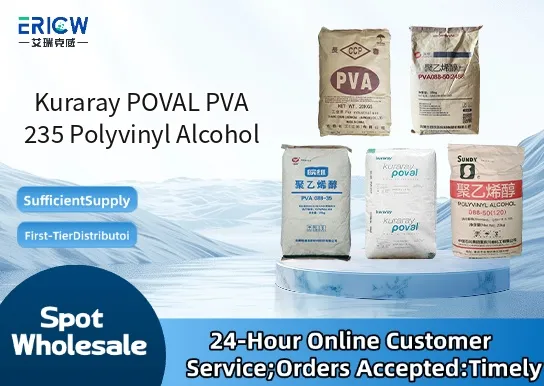
High water solubility with rapid dissolution in cold and warm water.
Excellent film-forming capability yielding strong, flexible, and transparent films.
Superior adhesion to polar substrates including paper, cellulose, metals, and ceramics.
Good compatibility with starch, acrylics, and other water-soluble polymers.
Low residual acetate content ensuring high hydrophilicity and biodegradability.
Water-soluble packaging films for agrochemicals and detergent pods.
Binders in ceramic and refractory green bodies for improved dry strength.
Thickener and stabilizer in textile printing pastes and pigment dispersions.
Adhesive component in paper coating and laminating formulations.
Protective colloid in emulsion polymerization of vinyl acetate and styrene-butadiene.
| Chemical Type | Polyvinyl alcohol (partially hydrolyzed) |
| Product Form | White to off-white free-flowing powder |
| Appearance | Free-flowing granular or powdered solid |
| Saponification Degree | 87–89 mol% (nominal) |
| Viscosity (4% aqueous solution, 20°C) | 22.0–24.0 mPa·s |
| Residual Acetate Content | 11–13 wt% |
| pH (5% aqueous solution) | 5.0–6.5 |
| Moisture Content | ≤5.0 wt% |
Q1: What is the typical degree of hydrolysis and molecular weight range for POVAL PVA 235?
A: POVAL PVA 235 is a partially hydrolyzed polyvinyl alcohol grade with a nominal degree of hydrolysis in the mid- to high-80% range, offering a balanced combination of water solubility and film-forming capability. Its viscosity-average molecular weight falls within the medium-range category, supporting good solution rheology and cohesive strength in aqueous formulations.
Q2: How does POVAL PVA 235 perform in adhesive applications compared to fully hydrolyzed PVAs?
A: Due to its partial hydrolysis, POVAL PVA 235 exhibits enhanced compatibility with hydrophobic components and improved flexibility in dried films—making it particularly suitable for paperboard laminating adhesives, textile sizing, and binder systems where toughness and reduced brittleness are desired. It generally provides better wet tack and substrate adhesion on semi-porous surfaces than highly hydrolyzed grades.
Q3: Is POVAL PVA 235 suitable for use in water-soluble packaging films?
A: Yes—POVAL PVA 235 is commonly selected for water-soluble packaging applications requiring controlled dissolution profiles and mechanical integrity during handling. Its partial hydrolysis imparts moderate water resistance in humid conditions while maintaining reliable cold-water solubility under standard use conditions. Performance in final film form depends on formulation additives, drying conditions, and intended dissolution environment.
Q4: What are recommended dissolution practices for POVAL PVA 235?
A: For optimal dispersion and dissolution, gradual addition of powder into cold or ambient water with vigorous agitation is recommended to prevent agglomeration. A pre-swelling step followed by gentle heating to 80–90°C typically achieves full dissolution within 30–60 minutes. Avoid direct addition to boiling water, as surface gelation may hinder complete hydration.
Contact With Us:
E-mail: wangxingqiang@ericwchem.com
Have a Questions? Call Us:
Add:
Building A1, Jiete Industrial Park, Huangpu District, Guangzhou City, Guangdong Province, China