English
 Español
 tiếng việt
 русский
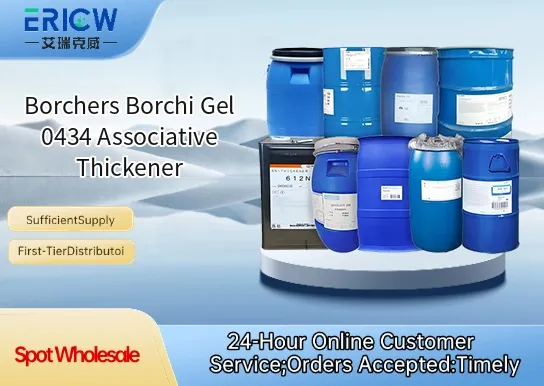
High-efficiency associative thickening in low-shear and high-shear conditions.
Excellent compatibility with anionic, nonionic, and amphoteric surfactants.
Provides outstanding viscosity build-up and rheology control in water-based formulations.
Enhances sag resistance and improves leveling without compromising flow properties.
Stable performance across broad pH range (pH 4–11) and moderate electrolyte concentrations.
Architectural paints and coatings (interior/exterior latex paints).
Industrial maintenance coatings and coil coatings.
Water-based adhesives and sealants.
Car care products including shampoos and waxes.
Printing inks and functional aqueous dispersions.
| Chemical Type | Hydrophobically modified ethoxylated urethane (HEUR) |
| Product Form | Clear to slightly hazy viscous liquid |
| Appearance | Light yellow to amber liquid |
| Primary Applications | Rheology modifier for water-based systems |
| Key Features | Non-ionic, associative, shear-thinning |
| Recommended Use Level | 0.1–1.5 wt% (based on total formulation) |
| pH Range (as supplied) | 5.5–7.5 |
| Storage Conditions | Store at 5–35°C; protect from freezing and prolonged UV exposure |
Q1: What type of rheology does Borchers Borchi Gel 0434 impart to aqueous formulations?
A: Borchi Gel 0434 is an associative thickener that delivers pronounced shear-thinning behavior and strong mid-to-high-shear viscosity control, supporting excellent flow leveling and sag resistance while maintaining good brushability and spray atomization in architectural and industrial coatings.
Q2: How does Borchi Gel 0434 differ from cellulosic or non-associative thickeners?
A: Unlike cellulosics, Borchi Gel 0434 functions via hydrophobic association in water, resulting in lower sensitivity to electrolytes, improved compatibility with surfactants and coalescing agents, and enhanced tolerance to pH fluctuations—making it particularly suitable for complex, high-performance emulsion systems.
Q3: Is Borchi Gel 0434 compatible with biocides and common preservation systems?
A: Yes, Borchi Gel 0434 demonstrates good stability in the presence of standard isothiazolinone- and formaldehyde-releasing biocides when used at typical dosage levels; however, compatibility should be verified empirically in final formulations due to potential interactions with specific preservative chemistries.
Q4: What is the recommended addition method for optimal performance?
A: For best results, Borchi Gel 0434 should be added during the let-down stage, preferably after dispersants and pigments but before surfactants and coalescents; gentle mixing is advised to avoid excessive shear degradation and ensure uniform dispersion without air entrapment.
Contact With Us:
E-mail: wangxingqiang@ericwchem.com
Have a Questions? Call Us:
Add:
Building A1, Jiete Industrial Park, Huangpu District, Guangzhou City, Guangdong Province, China