English
 Español
 tiếng việt
 русский
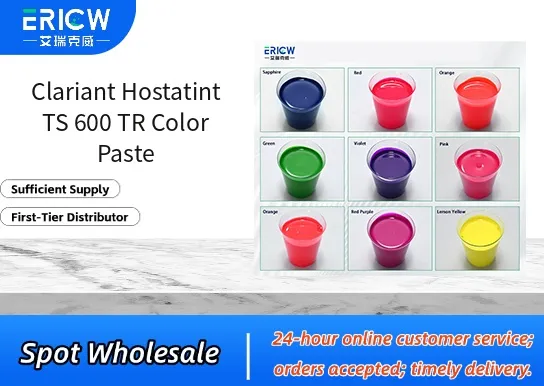
Highly concentrated pigment dispersion for efficient coloration with low dosage requirements.
Excellent thermal and shear stability suitable for high-temperature polymer processing.
Optimized for polyolefin (PP, PE) and engineering thermoplastics including ABS and PS.
Low migration and blooming resistance ensuring long-term color fidelity in end products.
Free of heavy metals and compliant with major global regulatory frameworks including EU REACH and US FDA 21 CFR.
Coloration of polypropylene (PP) fibers and nonwovens for hygiene and medical applications.
Colored polyethylene (PE) films used in packaging and agricultural mulch films.
Automotive interior components requiring consistent color and UV resistance.
Household appliances and consumer electronics housings made from ABS or PS.
Technical parts in white goods where dimensional stability and color consistency are critical.
| Chemical Type | Organic pigment-based color paste |
| Product Form | Paste (carrier: polyolefin-compatible wax/oil blend) |
| Appearance | Homogeneous, viscous paste; color-specific shade |
| Primary Applications | Polyolefins (PP, HDPE, LDPE), ABS, PS |
| Key Features | Thermally stable, low-migration, high dispersion quality |
| Benefits | Consistent batch-to-batch color, excellent melt processability, reduced dusting risk |
| Storage Conditions | Store in original sealed container at 5–30 °C; protect from freezing and direct sunlight |
| Regulatory Compliance | REACH registered; compliant with FDA 21 CFR §178.3297 (for food-contact plastics) |
Q1: What is the primary application field for Hostatint TS 600 TR Color Paste?
A: Hostatint TS 600 TR is specifically developed for coloring thermoplastic elastomers (TPEs), including TPE-S, TPE-V, and TPE-E compounds, where high dispersion stability, thermal resistance during processing, and consistent color performance are critical.
Q2: Is this color paste suitable for food-contact or medical-grade TPE applications?
A: Hostatint TS 600 TR is formulated with pigments and carriers intended for use in non-food-contact TPE applications. For food-contact or medical-grade uses, formal regulatory assessment—including compatibility testing and compliance verification with applicable regional requirements—is required prior to implementation.
Q3: How should Hostatint TS 600 TR be incorporated into TPE compounds?
A: It is typically added directly to the base polymer during compounding—via side-stuffer feeder, gravimetric dosing, or melt blending—and disperses readily under standard TPE processing conditions (e.g., extrusion or injection molding). Pre-drying is not required, but optimal dispersion is achieved with sufficient shear and residence time.
Q4: What is the typical dosage range for achieving target color intensity?
A: Dosage depends on formulation requirements and desired shade depth, but it is generally used at low concentrations—typically ranging from 0.1% to 2% by weight relative to the base TPE—due to its high pigment loading and efficient dispersion characteristics.
Contact With Us:
E-mail: wangxingqiang@ericwchem.com
Have a Questions? Call Us:
Add:
Building A1, Jiete Industrial Park, Huangpu District, Guangzhou City, Guangdong Province, China