English
 Español
 tiếng việt
 русский
Enhanced thermal stability for high-performance epoxy systems operating up to 180 °C continuous service.
Low viscosity (250–400 mPa·s at 25 °C) enabling excellent flow, wetting, and filler dispersion in formulated resins.
Reduced volatility and amine odor compared to conventional aromatic amines, improving workplace handling safety.
Balanced reactivity—faster than DDM yet controllable pot life (>4 hours at 25 °C with standard DGEBA epoxy).
Excellent adhesion to carbon fiber, glass fiber, and metallic substrates without additional primers.
Aerospace composite tooling and structural components requiring elevated Tg and dimensional stability.
High-voltage electrical insulation systems, including castings and encapsulants for transformers and bushings.
Wind turbine blade root joints and spar cap bonding where fatigue resistance and thermal cycling performance are critical.
Automotive under-hood composites exposed to sustained thermal and chemical stress.
Industrial flooring and heavy-duty protective coatings demanding rapid strength build and chemical resistance.
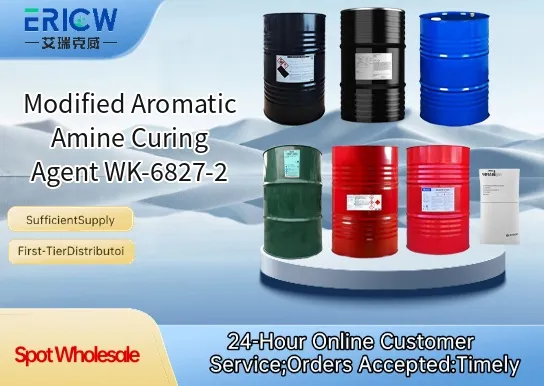
| Chemical Type | Modified aromatic diamine |
| Product Form | Liquid |
| Appearance | Clear to pale amber viscous liquid |
| Primary Applications | Epoxy resin curing agent for high-performance composites and coatings |
| Key Features | Low volatility, high Tg capability, improved compatibility with bisphenol-A and novolac epoxies |
| Benefits | Extended working time, reduced post-cure requirements, enhanced interlaminar shear strength |
| Storage Stability | 12 months unopened at 15–25 °C; protect from moisture and direct sunlight |
| Handling Precautions | Use in well-ventilated areas; wear nitrile gloves and eye protection per SDS guidelines |
Q1: What are the key advantages of WK-6827-2 compared to conventional aromatic amine curing agents?
A: WK-6827-2 offers improved handling safety and reduced volatility due to its modified molecular structure, while retaining strong reactivity with epoxy resins. It typically delivers enhanced thermal stability and mechanical performance in cured systems without requiring elevated post-cure temperatures.
Q2: Is WK-6827-2 suitable for applications requiring low-temperature cure profiles?
A: Yes — WK-6827-2 is formulated to provide effective reactivity at ambient to moderately elevated temperatures (e.g., 15–40 °C), making it well-suited for coatings, adhesives, and composites where energy-efficient or ambient-cure processing is preferred.
Q3: How does WK-6827-2 influence pot life and gel time in epoxy formulations?
A: Compared to unmodified aromatic amines, WK-6827-2 generally extends working time under standard conditions while maintaining acceptable gel onset. Actual pot life depends on formulation variables including epoxy type, filler content, and ambient temperature.
Q4: Can WK-6827-2 be used in food-contact or potable water applications?
A: WK-6827-2 is not pre-qualified for direct food-contact or potable water use. Formulators must conduct full regulatory evaluation—including migration testing and compliance verification—based on final cured product composition and intended application.
Contact With Us:
E-mail: wangxingqiang@ericwchem.com
Have a Questions? Call Us:
Add:
Building A1, Jiete Industrial Park, Huangpu District, Guangzhou City, Guangdong Province, China