English
 Español
 tiếng việt
 русский
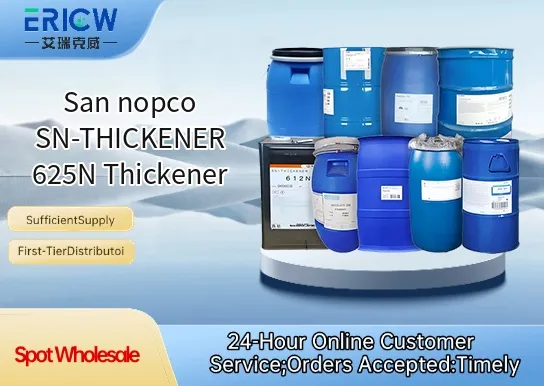
High-efficiency associative thickening for stable rheology control in water-based systems.
Excellent compatibility with anionic, nonionic, and amphoteric surfactants.
Low-odor, non-volatile formulation suitable for low-VOC and eco-friendly formulations.
Promotes outstanding sag resistance and brush/roller application performance.
Delivers consistent viscosity build-up across a broad pH range (pH 4–11).
Architectural waterborne interior and exterior paints.
Water-based industrial maintenance coatings.
Textile printing pastes and pigment dispersions.
Adhesives and construction sealants requiring shear-thinning behavior.
Carpet and upholstery cleaning formulations.
| Chemical Type | Hydrophobically modified ethoxylated urethane (HEUR) |
| Product Form | Clear to slightly hazy liquid |
| Appearance | Colorless to pale yellow viscous liquid |
| pH (1% aqueous solution) | 6.0 – 8.0 |
| Active Content | ~30% w/w |
| Density (25°C) | 1.02 – 1.06 g/cm³ |
| Solubility | Water-miscible; forms clear solutions upon proper dilution |
| Storage Stability | Stable for ≥12 months at 5–35°C in sealed original container |
Q1: What type of thickening mechanism does SN-THICKENER 625N employ?
A: SN-THICKENER 625N functions primarily through associative thickening, where hydrophobic groups interact with surfactants or polymer micelles in aqueous systems to form a transient 3D network, delivering efficient viscosity build and excellent shear-thinning behavior.
Q2: Is SN-THICKENER 625N compatible with anionic, nonionic, and zwitterionic surfactant systems?
A: Yes — SN-THICKENER 625N demonstrates broad compatibility across common surfactant classes, including anionic (e.g., LAS, AES), nonionic (e.g., alcohol ethoxylates), and zwitterionic systems. Performance may vary depending on ionic strength and pH, so formulation screening is recommended.
Q3: How should SN-THICKENER 625N be incorporated into formulations for optimal performance?
A: It is typically added during the post-addition phase after primary surfactants and electrolytes are fully dissolved. Pre-dilution in water or co-solvent is advised to ensure uniform dispersion. Avoid high-shear addition at low temperatures, as this may hinder full hydration and network development.
Q4: Does SN-THICKENER 625N require pH adjustment for activation?
A: Unlike some alkali-swellable thickeners, SN-THICKENER 625N does not rely on pH-triggered swelling. It delivers effective thickening across a wide pH range (approximately 4–10), though extreme pH conditions may affect long-term stability and rheological consistency.
Q5: What are typical dosage levels for SN-THICKENER 625N in household cleaning formulations?
A: Dosage depends on target viscosity, formulation complexity, and desired flow properties, but it is generally used at low concentrations — typically ranging from 0.1% to 2% by weight — with most liquid detergent applications falling between 0.3% and 1.2%.
Contact With Us:
E-mail: wangxingqiang@ericwchem.com
Have a Questions? Call Us:
Add:
Building A1, Jiete Industrial Park, Huangpu District, Guangzhou City, Guangdong Province, China