English
 Español
 tiếng việt
 русский
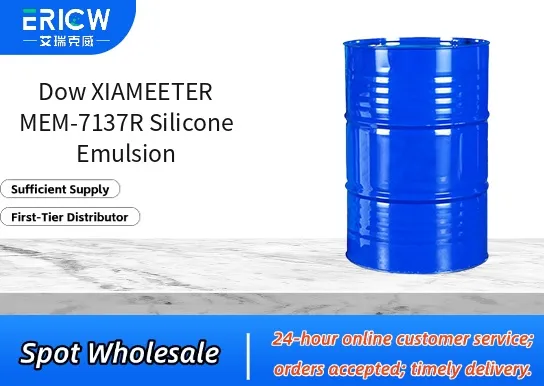
Highly stable anionic silicone emulsion with excellent shelf life and freeze-thaw resistance.
Delivers superior softening, lubricity, and hydrophobicity to treated substrates.
Compatible with cationic, nonionic, and many anionic systems in formulation blends.
Low foaming profile suitable for high-shear processing and continuous industrial applications.
Provides durable surface modification without migration or blooming on cured films.
Textile finishing for cotton, polyester, and blended fabrics to enhance hand feel and wrinkle recovery.
Leather conditioning and top-coat additives to improve suppleness and water repellency.
Personal care formulations including conditioners, shampoos, and skin creams for sensory enhancement.
Industrial coatings and paper treatments to reduce surface friction and improve slip performance.
Nonwovens treatment for medical gowns and hygiene products to optimize drape and barrier properties.
| Chemical Type | Anionic polydimethylsiloxane (PDMS) emulsion |
| Product Form | Opaque white liquid |
| Appearance | Homogeneous, low-viscosity emulsion |
| Active Content (w/w %) | 30 ± 1% |
| pH (1% aqueous solution) | 5.5 – 6.5 |
| Density (25°C) | 0.98 – 1.02 g/cm³ |
| Particle Size (D50) | 0.15 – 0.25 µm |
| Primary Applications | Textile, leather, personal care, industrial coatings, nonwovens |
Q1: What is the primary function of MEM-7137R in coating and ink formulations?
A: MEM-7137R is a non-ionic, anionic-stabilized silicone emulsion designed to provide surface leveling, substrate wetting, and foam control in water-based coatings, inks, and adhesives. It helps reduce surface defects such as craters, orange peel, and pinholes while improving gloss uniformity and substrate coverage.
Q2: Is MEM-7137R compatible with common water-based polymer systems?
A: Yes, MEM-7137R exhibits good compatibility with acrylics, styrene-acrylics, vinyl acetate copolymers, and polyurethane dispersions. Compatibility should be verified in the final formulation due to variations in pH, ionic strength, and surfactant package.
Q3: How should MEM-7137R be incorporated into a formulation?
A: It is recommended to add MEM-7137R during the let-down stage, after the main binder and pigments have been dispersed. Stir gently to avoid excessive air entrainment. Pre-dilution with water may improve incorporation in sensitive systems.
Q4: Does MEM-7137R affect film formation or drying behavior?
A: MEM-7137R typically does not interfere with film formation or significantly alter drying kinetics at recommended use levels. However, high addition rates may delay surface drying or impact intercoat adhesion, so dosage optimization is advised for each application.
Q5: Can MEM-7137R be used in food-contact or regulated applications?
A: MEM-7137R is not pre-approved for direct food-contact applications. Customers intending to use it in regulated end uses must conduct their own suitability assessment, including compatibility testing and regulatory review, in accordance with applicable local and regional requirements.
Contact With Us:
E-mail: wangxingqiang@ericwchem.com
Have a Questions? Call Us:
Add:
Building A1, Jiete Industrial Park, Huangpu District, Guangzhou City, Guangdong Province, China