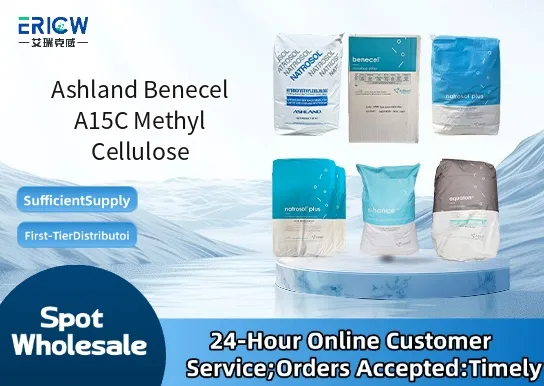
Features Of Ashland Benecel A15C Methyl Cellulose
Highly water-soluble methyl cellulose polymer with rapid hydration and low solution viscosity.
Excellent thermal gelation profile—forms reversible gels upon heating, ideal for controlled rheology applications.
Provides superior film-forming capability and surface protection in aqueous systems.
Offers outstanding water retention in cementitious and gypsum-based building materials.
Non-ionic, pH-stable, and compatible with a broad range of additives including surfactants, salts, and biocides.
Typical Applications Of Ashland Benecel A15C Methyl Cellulose
Tile adhesives and thin-set mortars for enhanced workability and open time.
Self-leveling underlayments requiring high flow and minimal sag.
Exterior insulation finishing systems (EIFS) base and finish coats.
Grouts and repair mortars where water retention and cohesion are critical.
Pharmaceutical tablet binders and controlled-release matrix formers.
Specifications Of Ashland Benecel A15C Methyl Cellulose
| Chemical Type | Methyl cellulose ether |
| Product Form | White to off-white free-flowing powder |
| Appearance | Free-flowing granular powder |
| Primary Applications | Construction mortars, EIFS, pharmaceutical excipients |
| Key Features | Thermal gelation, high water retention, low viscosity solution |
| Benefits | Improved workability, extended open time, reduced cracking |
| pH (1% aqueous solution) | 5.0–8.0 |
| Viscosity (2% solution at 20°C) | 12–18 mPa·s (Brookfield RV, spindle #3, 20 rpm) |
Ashland Benecel A15C Methyl Cellulose – Frequently Asked Questions (FAQ)
Q1: What is the primary functional role of Benecel A15C in aqueous formulations?
A: Benecel A15C functions primarily as a water-soluble thickener and rheology modifier, providing viscosity enhancement, suspension stabilization, and improved film-forming capability in cold-water dissolving systems.
Q2: How does Benecel A15C differ from higher-viscosity methyl cellulose grades like A4M or A15M?
A: Benecel A15C offers a lower nominal viscosity profile compared to A4M or A15M, making it suitable for applications requiring moderate thickening with enhanced flow characteristics and easier incorporation—particularly where high shear stability and low gelation temperature are advantageous.
Q3: Is Benecel A15C compatible with common preservatives and electrolytes used in industrial coatings or construction mortars?
A: Yes, Benecel A15C demonstrates good compatibility with many widely used biocides, antifoams, and inorganic salts found in construction and coating formulations, though performance should be verified under actual formulation conditions due to potential interactions with multivalent ions or highly acidic/basic components.
Q4: Can Benecel A15C be used in food-contact applications?
A: Benecel A15C is manufactured to meet specifications appropriate for certain non-food industrial uses; it is not certified for direct food contact or as a food additive. Customers requiring food-grade functionality should consult Ashland’s portfolio of food-compliant cellulose derivatives.
 English
 Español
 tiếng việt
 русский