English
 Español
 tiếng việt
 русский
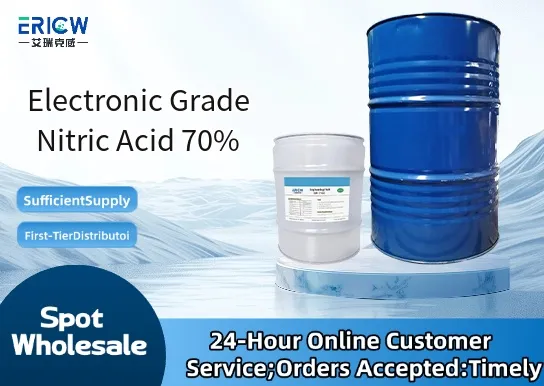
Ultra-low metallic impurities (≤10 ppt for Na, K, Ca, Fe, Cu, Ni, Cr, Zn, Al, Mg)
Controlled anionic contaminants (Cl⁻ ≤5 ppt, SO₄²⁻ ≤10 ppt, PO₄³⁻ ≤5 ppt)
Manufactured and packaged under ISO Class 4 (Class 10) cleanroom conditions
Double-submicron filtration (0.1 µm PTFE membrane) post-distillation
Traceable lot documentation with full ICP-MS and IC analytical certificates
Silicon wafer surface cleaning and native oxide removal in front-end semiconductor fabrication
Photoresist stripping and post-etch residue cleaning for advanced logic and memory devices
Pre-diffusion cleaning of GaAs, SiC, and GaN substrates in compound semiconductor processing
Etchant component in mixed acid formulations for copper and aluminum interconnect patterning
Calibration standard preparation and reference material dilution in analytical labs serving microelectronics
| Chemical Type | Nitric acid (HNO₃), ultra-high purity |
| Product Form | Liquid, aqueous solution |
| Concentration (w/w) | 69.0–70.5% HNO₃ |
| Appearance | Clear, colorless to pale yellow liquid (no particulates or haze) |
| Density (20 °C) | 1.40–1.42 g/cm³ |
| Primary Applications | Semiconductor wafer cleaning, etch process chemistry, analytical standardization |
| Key Features | Low volatility residue, minimal carbon residue (<10 ppb), non-volatile acid residue (NVAR) <5 ng/cm² after evaporation |
| Regulatory Compliance | REACH compliant; RoHS 2015/863 Annex II compliant; no SVHCs above threshold |
| Common Compatible Systems | Suitability |
| SEMI F57-Approved Wet Bench Tools (e.g., Modutek, Technic, Screen) | Highly Recommended – Fully validated for single-wafer and batch immersion systems |
| DI Water Dilution Systems (e.g., Entegris Aton™, Jenton Dispense) | Highly Recommended – Compatible with fluoropolymer fluid paths and low-particulate manifolds |
| Stainless Steel 316L Storage & Transfer Lines | Recommended – With passivation and dedicated use; avoid prolonged static contact |
| PFA, ETFE, and FEP-lined Chemical Delivery Piping | Highly Recommended – Chemically inert and low-leach performance confirmed |
Q1: What is the CAS Registry Number for Electronic Grade Nitric Acid 70%?
A: The CAS number is 7697-37-2, identical to nitric acid; grade designation is defined by impurity profile and handling—not molecular identity.
Q2: Can this product be diluted on-site with deionized water, and what purity level is required?
A: Yes—dilution is common. Use ≥18.2 MΩ·cm ultrapure water (UPW) meeting SEMI F63 specifications; lower resistivity may introduce ionic contamination or particle generation.
Q3: How does Electronic Grade Nitric Acid 70% differ from Semiconductor Grade or Technical Grade?
A: Electronic Grade imposes stricter limits on metallics (ppt vs. ppb), anions, particles (<1 particle/mL ≥0.2 µm), and organic extractables—validated per SEMI C35 and ASTM E1355 standards.
Q4: Is leachable metal migration observed during storage in fluoropolymer containers?
A: No significant migration occurs when stored in certified PFA or FEP bottles at ambient temperature; accelerated testing per SEMI F57 shows <1 ppt increase in Fe/Cu after 90 days.
Q5: Does this product meet USP/EP requirements for pharmaceutical use?
A: No—this grade is formulated exclusively for microelectronics manufacturing and lacks USP/EP monograph validation, residual solvent testing, or endotoxin controls required for pharma applications.
Contact With Us:
E-mail: wangxingqiang@ericwchem.com
Have a Questions? Call Us:
Add:
Building A1, Jiete Industrial Park, Huangpu District, Guangzhou City, Guangdong Province, China
![4-[(2,3-Dihydrothieno[3,4-b]-1,4-Dioxin-2-yl)Methoxy]-1-Butanesulfonic Acid Sodium Salt](/uploads/image/20260922/4-2-3-dihydrothieno-3-4-b-1-4-dioxin-2-yl-methoxy-1-butanesulfonic-acid-sodium-s_fab320bf.webp "4-[(2,3-Dihydrothieno[3,4-b]-1,4-Dioxin-2-yl)Methoxy]-1-Butanesulfonic Acid Sodium Salt")