English
 Español
 tiếng việt
 русский
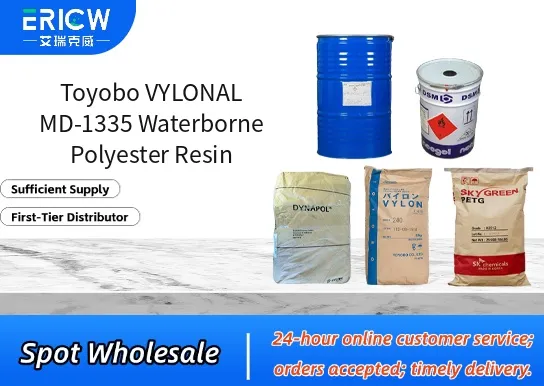
Low-VOC, environmentally compliant waterborne formulation meeting stringent global regulatory requirements.
Excellent film-forming capability with balanced hardness and flexibility for durable coatings.
Good compatibility with acrylic emulsions, crosslinkers (e.g., aziridine or carbodiimide types), and pigment dispersions.
Stable storage at 5–30°C with shelf life of ≥12 months under sealed conditions.
Low odor and non-hazardous handling profile—ideal for indoor and occupational-safe applications.
Waterborne industrial maintenance coatings for metal substrates.
High-performance interior architectural coatings requiring scrub resistance and gloss retention.
Base resin for eco-friendly wood coatings in furniture and cabinetry.
Component in waterborne coil coating primers and topcoats.
| Chemical Type | Aliphatic waterborne polyester dispersion |
| Product Form | Liquid dispersion |
| Appearance | Opaque white to light yellow liquid |
| pH (25°C) | 7.5–8.5 |
| Solids Content (wt%) | 35.0 ± 1.0 |
| Viscosity (mPa·s, Brookfield LVT, #2 spindle, 60 rpm, 25°C) | 150–400 |
| Density (g/cm³, 25°C) | 1.02–1.05 |
| Minimum Film Formation Temperature (MFFT) | ≈25°C |
Q1: What are the primary application areas for VYLONAL MD-1335?
A: VYLONAL MD-1335 is primarily formulated into waterborne industrial coatings, including metal primers, topcoats, and coil coating systems where low VOC content, good film formation, and compatibility with crosslinkers such as melamine or polyisocyanates are required.
Q2: How does MD-1335 differ from solvent-based polyester resins in terms of formulation handling?
A: As a waterborne dispersion, MD-1335 eliminates the need for high-boiling aromatic solvents and reduces flammability hazards during manufacturing. It typically requires pH adjustment and careful selection of co-solvents and surfactants to ensure colloidal stability and compatibility with other aqueous components.
Q3: Is MD-1335 compatible with common crosslinking agents used in ambient- or forced-dry systems?
A: Yes — MD-1335 is designed to react efficiently with amino resins (e.g., melamine-formaldehyde) under thermal curing conditions and shows good compatibility with blocked isocyanate crosslinkers for ambient-cure or low-bake applications, depending on catalyst selection and formulation pH.
Q4: What viscosity and solids content characteristics should formulators expect?
A: MD-1335 is supplied as a stable aqueous dispersion with moderate viscosity and typical non-volatile content in the range of 30–40% by weight. Its rheology supports easy incorporation into coating formulations without excessive thickening, though shear history and ionic strength may influence flow behavior.
Q5: Does MD-1335 require special storage or handling precautions?
A: Store in tightly sealed containers at temperatures between 5°C and 35°C, avoiding freezing and prolonged exposure to direct sunlight. Prior to use, gentle mixing is recommended to ensure uniform dispersion; avoid high-shear agitation that could destabilize the particle morphology.
Contact With Us:
E-mail: wangxingqiang@ericwchem.com
Have a Questions? Call Us:
Add:
Building A1, Jiete Industrial Park, Huangpu District, Guangzhou City, Guangdong Province, China