English
 Español
 tiếng việt
 русский
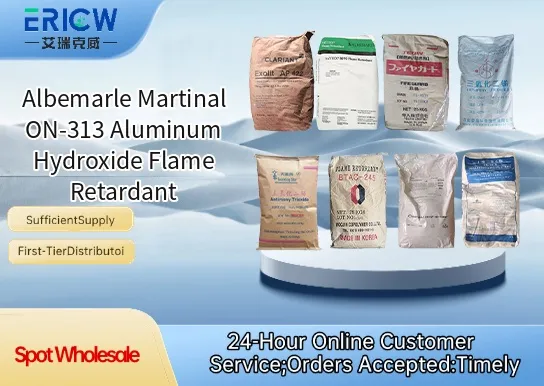
High-purity, surface-treated aluminum hydroxide designed for superior flame retardancy and smoke suppression.
Optimized particle size distribution for excellent dispersion in polymer matrices and improved mechanical property retention.
Low abrasivity minimizes wear on processing equipment during compounding and extrusion.
Thermally stable up to ~200 °C, enabling compatibility with common engineering thermoplastics including polyolefins and PVC.
Halogen-free and environmentally compliant—meets RoHS and REACH requirements for restricted substances.
Wire and cable insulation and jacketing compounds.
Flame-retardant polypropylene (PP) and polyethylene (PE) for automotive interior parts.
Building and construction materials, including PVC-based flooring and wall coverings.
Electrical enclosures and housings requiring UL 94 V-0 or V-1 rated performance.
Thermoplastic elastomers (TPEs) used in consumer electronics and appliance components.
| Chemical Type | Aluminum hydroxide, Al(OH)₃ |
| Product Form | White, free-flowing powder |
| Appearance | Off-white to white granular powder |
| Primary Applications | Halogen-free flame retardant for polymers |
| Key Features | Surface-treated, low abrasion, high thermal stability |
| Benefits | Reduces smoke density, improves char formation, enhances UL 94 rating |
| Density (g/cm³) | 2.40–2.45 |
| Loss on Ignition (LOI), % (1000 °C) | 34.5–35.5 |
Q1: What is the primary mechanism by which Martinal ON-313 provides flame retardancy?
A: Martinal ON-313 functions primarily through endothermic decomposition, absorbing heat and releasing water vapor upon exposure to elevated temperatures. This cools the substrate and dilutes flammable gases in the flame zone, thereby suppressing ignition and slowing fire propagation.
Q2: Is Martinal ON-313 suitable for use in halogen-free polymer systems?
A: Yes — Martinal ON-313 is a halogen-free, inorganic aluminum hydroxide-based flame retardant specifically designed for applications requiring low smoke, low toxicity, and compliance with evolving environmental and safety regulations.
Q3: How does particle size distribution affect processing and performance in compounded polymers?
A: Martinal ON-313 features a controlled, narrow particle size distribution optimized for good dispersion in thermoplastics and elastomers. This supports efficient compounding, minimizes wear on processing equipment, and helps maintain mechanical properties at effective loading levels.
Q4: Can Martinal ON-313 be used in wire & cable jacketing compounds?
A: Yes — it is widely employed in low-smoke, zero-halogen (LSZH) wire and cable compounds, where its thermal stability profile and compatibility with common polymer matrices such as polyolefins and EVA support both flame retardancy and processability.
Contact With Us:
E-mail: wangxingqiang@ericwchem.com
Have a Questions? Call Us:
Add:
Building A1, Jiete Industrial Park, Huangpu District, Guangzhou City, Guangdong Province, China