English
 Español
 tiếng việt
 русский
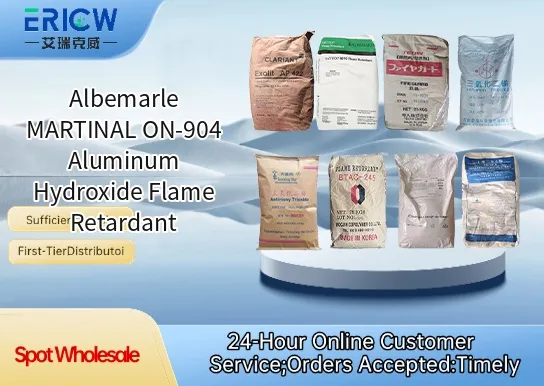
High-purity, surface-treated aluminum hydroxide designed for superior flame retardancy and smoke suppression.
Optimized particle size distribution for excellent dispersion in polymer matrices and minimal impact on mechanical properties.
Low abrasivity ensures reduced wear on processing equipment during compounding and extrusion.
Thermally stable up to ~200 °C, enabling compatibility with common engineering thermoplastics and elastomers.
Halogen-free and RoHS-compliant, supporting sustainable material design and regulatory compliance.
Flame-retarded polyolefins (e.g., PP, PE) for wire & cable jacketing and sheathing.
Fire-safe thermoplastic elastomers (TPEs) used in automotive interior components.
Low-smoke, halogen-free compounds for building & construction materials including insulation and ducting.
Flame-retardant masterbatches for injection-molded electrical enclosures and connectors.
| Chemical Type | Aluminum hydroxide, Al(OH)₃ |
| Product Form | White, free-flowing powder |
| Appearance | Off-white to white granular powder |
| Primary Applications | Halogen-free flame retardant for polymers |
| Key Features | Surface-treated, low abrasion, high thermal stability |
| Benefits | Reduces fire spread, suppresses smoke and toxic gases, enhances UL94 V-0 performance |
| Typical D₅₀ Particle Size | ~1.8–2.2 µm |
| LOI (Limiting Oxygen Index) | ≥35% (in 60 wt% loaded HDPE) |
Q1: What distinguishes MARTINAL ON-904 from other aluminum hydroxide flame retardants?
A: MARTINAL ON-904 is a surface-treated, ultrafine aluminum hydroxide specifically engineered for enhanced dispersion and compatibility in demanding polymer systems, particularly low-viscosity or high-clarity formulations where conventional grades may cause haze or processing challenges.
Q2: Is MARTINAL ON-904 suitable for use in halogen-free flame-retarded polyolefins?
A: Yes — it is widely used in halogen-free flame-retardant polypropylene and polyethylene compounds, offering effective endothermic decomposition and smoke suppression while maintaining good mechanical properties at appropriate loading levels.
Q3: How does the surface treatment affect processing and final part performance?
A: The proprietary surface treatment improves interfacial adhesion with non-polar polymers, reduces agglomeration during compounding, enhances melt flow stability, and helps preserve tensile strength and impact resistance in finished parts compared to untreated aluminum hydroxide.
Q4: Can MARTINAL ON-904 be used in thermoplastic elastomers (TPEs) or flexible PVC applications?
A: Yes — its fine particle size and tailored surface chemistry support good dispersion in soft compound systems, contributing to flame retardancy without excessive stiffening or compromising elasticity in many TPE and flexible PVC formulations.
Contact With Us:
E-mail: wangxingqiang@ericwchem.com
Have a Questions? Call Us:
Add:
Building A1, Jiete Industrial Park, Huangpu District, Guangzhou City, Guangdong Province, China