English
 Español
 tiếng việt
 русский
Highly selective for linear alpha olefin (LAO) production via ethylene oligomerization.
Thermally stable under continuous industrial operating conditions up to 120 °C.
Low metal leaching ensures extended catalyst life and reduced downstream purification burden.
Compatible with standard slurry-phase reactor systems and existing process infrastructure.
Controlled molecular weight distribution enables precise tailoring of C4–C10 olefin fractions.
Production of 1-butene for LLDPE comonomer applications.
Manufacture of 1-hexene and 1-octene used in premium polyethylene resins.
Synthesis of detergent-range linear alpha olefins (C10–C14) for LAB production.
On-purpose LAO supply for synthetic lubricant base stocks and plasticizer alcohols.
Integrated petrochemical units requiring high-yield, low-byproduct ethylene conversion.
| Chemical Type | Supported transition metal complex (nickel-based) |
| Product Form | Free-flowing granular solid |
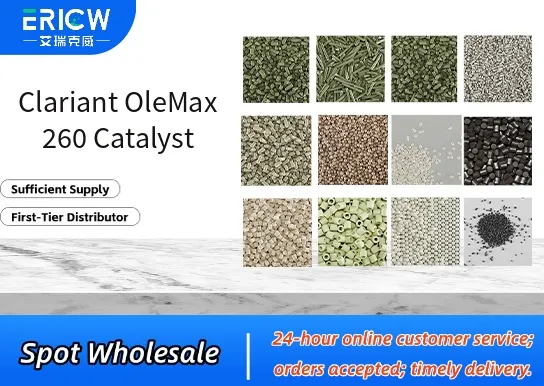
| Appearance | Gray to dark brown granules |
| Primary Applications | Ethylene oligomerization to linear alpha olefins (C4–C14) |
| Key Features | High selectivity, thermal robustness, low fouling tendency |
| Benefits | Improved process efficiency, reduced catalyst consumption, consistent product quality |
| Storage Conditions | Under inert atmosphere (N₂), dry, <30 °C |
| Handling Precautions | Air-sensitive; use under nitrogen glovebox or controlled environment |
Q1: What is the primary function of OleMax 260 in polyolefin processing?
A: OleMax 260 is a highly active metallocene-based catalyst designed to enable precise control over polymer microstructure—particularly for producing linear low-density polyethylene (LLDPE) and ethylene copolymers with narrow molecular weight distribution and uniform comonomer incorporation.
Q2: How does OleMax 260 differ from conventional Ziegler–Natta catalysts?
A: Unlike traditional Ziegler–Natta systems, OleMax 260 offers single-site catalytic behavior, resulting in superior polymer homogeneity, enhanced comonomer response, and reduced reactor fouling—especially in gas-phase and slurry-phase polyethylene processes.
Q3: Is OleMax 260 compatible with common polyolefin process technologies?
A: Yes—it is engineered for robust performance in industrial-scale gas-phase, slurry-phase, and solution-phase polyethylene processes, and demonstrates good compatibility with standard alkylaluminum co-catalysts and external electron donors used in modern polyolefin plants.
Q4: What handling precautions should be observed during storage and dosing?
A: OleMax 260 is air- and moisture-sensitive. It must be stored under inert atmosphere (e.g., nitrogen or argon), protected from light and ambient humidity. Handling requires glove-box or purged-drum systems to maintain catalytic integrity and prevent premature deactivation.
Contact With Us:
E-mail: wangxingqiang@ericwchem.com
Have a Questions? Call Us:
Add:
Building A1, Jiete Industrial Park, Huangpu District, Guangzhou City, Guangdong Province, China