English
 Español
 tiếng việt
 русский
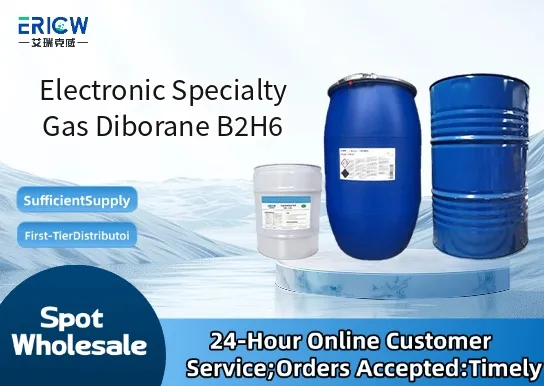
Ultra-high purity (99.999% minimum) with stringent control of metallic impurities (<1 ppb) and moisture (<0.1 ppm).
Consistent batch-to-batch performance validated via GC-MS and FTIR spectroscopy for semiconductor process repeatability.
Supplied in specially passivated stainless-steel cylinders with VCR® fittings to prevent adsorption, decomposition, or contamination.
Stabilized formulation with trace hydrogen dilution to enhance handling safety and thermal stability during delivery.
Compliant with SEMI C37 (Global Specifications for Electronic Gases) and ISO 8573-1 Class 1 for particulate and gaseous contaminants.
Dopant source for p-type epitaxial silicon (Si) and silicon-germanium (SiGe) layers in advanced CMOS and RF device fabrication.
Reactive precursor in low-pressure chemical vapor deposition (LPCVD) and atomic layer deposition (ALD) of boron-containing thin films.
Boron doping agent in ion implantation pre-amorphization and in-situ doped epitaxy for power semiconductors.
Catalyst promoter and reducing agent in high-k dielectric interface engineering and metal gate stack formation.
Key boron source for MEMS-based piezoresistive sensor fabrication requiring precise resistivity control.
| Chemical Type | Inorganic boron hydride compound |
| Product Form | Compressed liquefied gas (cylinder supply) |
| Appearance | Colorless, non-condensable gas with faint sweet odor at room temperature |
| Melting Point | −165 °C |
| Boiling Point | −92.5 °C |
| Primary Applications | Semiconductor dopant, CVD/ALD precursor, MEMS fabrication |
| Key Features | High reactivity, low decomposition temperature, excellent film conformality |
| Regulatory Compliance | SEMI C37-0321, ISO 8573-1:2010 Class 1, GHS hazard classification (Acute Tox. 2, Flam. Gas 1) |
| Common Compatible Systems | Suitability |
| Applied Materials Centura® PECVD & LPCVD Platforms | Highly Recommended – Optimized for diborane flow control and chamber conditioning |
| Lam Research VECTOR® Etch & Deposition Tools | Recommended – Verified compatibility with integrated gas delivery modules and purge protocols |
| Tokyo Electron (TEL) ACTIX® & ULTIMA® Series | Recommended – Supports precise mass flow and endpoint detection for boron-doped film growth |
| ASM International Eagle® & XP8™ ALD Systems | Suitable – Requires customized temperature-controlled manifold and inert carrier gas integration |
Q1: What is the CAS Registry Number for diborane (B₂H₆)?
A: The CAS Registry Number for diborane is 19287-45-7.
Q2: How does diborane compare to alternative boron precursors such as trimethylborate (TMB) or boron trichloride (BCl₃) in terms of doping efficiency?
A: Diborane offers superior boron incorporation efficiency and lower thermal budget than TMB, and avoids chlorine-related corrosion and residue issues associated with BCl₃—making it preferred for high-fidelity p-type doping in sub-28 nm nodes.
Q3: Is electronic-grade diborane compatible with standard stainless-steel gas distribution systems?
A: Yes—when supplied in passivated SS-316L cylinders with electropolished internal surfaces and VCR® connections, diborane maintains integrity in properly purged, moisture-free stainless-steel lines meeting SEMI F57 standards.
Q4: What safety certifications and transport classifications apply to electronic specialty diborane?
A: It is classified as UN 1928, Hazard Class 2.3 (Toxic Gas), Packing Group I; compliant with DOT 49 CFR, IMDG Code, and ADR/RID for transport; cylinders certified to ISO 9809-1 and PED 2014/68/EU.
Q5: Can diborane be used in continuous-flow ALD processes without significant precursor carryover or wall deposition?
A: Yes—when paired with optimized pulsing sequences, rapid N₂/H₂ purge cycles, and heated manifold zones (>80 °C), diborane demonstrates minimal residence time and negligible reactor wall accumulation in production-scale ALD tools.
Contact With Us:
E-mail: wangxingqiang@ericwchem.com
Have a Questions? Call Us:
Add:
Building A1, Jiete Industrial Park, Huangpu District, Guangzhou City, Guangdong Province, China