English
 Español
 tiếng việt
 русский
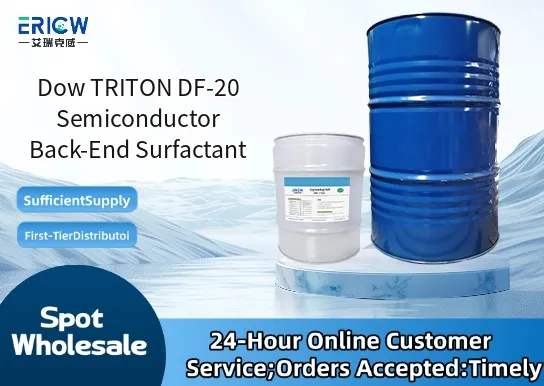
Engineered for ultra-low particle generation in semiconductor back-end cleaning and rinse processes.
Exceptional residue-free performance on copper, low-k dielectrics, and advanced packaging substrates.
Highly effective at reducing surface tension without compromising material compatibility or process stability.
Formulated with ultra-high purity to meet stringent SEMI S2/S8 and JEDEC standards for microelectronics manufacturing.
Non-ionic, alcohol-ethoxylate-based chemistry offering robust performance across varied pH and temperature conditions.
Copper post-CMP (Chemical Mechanical Planarization) rinse and drying enhancement.
Advanced packaging wafer-level underfill and molding compound interface conditioning.
Flip-chip bump cleaning and post-reflow residue mitigation.
Low-k dielectric surface treatment prior to passivation or bonding steps.
Wafer-level fan-out (FO-WLP) and 2.5D/3D IC assembly rinse optimization.
| Chemical Type | Non-ionic alcohol ethoxylate |
| Product Form | Clear, viscous liquid |
| Appearance | Colorless to pale yellow, homogeneous liquid |
| pH (1% aqueous solution, 25°C) | 6.0 – 7.5 |
| Primary Applications | Back-end-of-line (BEOL) rinse, drying, and interface conditioning |
| Key Features | Ultra-low ionic residue, non-volatile, non-corrosive, halogen-free |
| Benefits | Reduces water spotting, improves drying uniformity, minimizes pattern collapse risk |
| Regulatory Compliance | REACH registered; RoHS 2 compliant; no SVHCs above threshold per EU Annex XIV |
| Common Compatible Systems | Suitability |
| Deionized (DI) water-based spray-rinse tools | Highly Recommended – Optimized for low-flow, high-velocity rinse applications |
| Marangoni drying systems | Highly Recommended – Enhances meniscus stability and defect-free drying |
| Batch immersion cleaning platforms | Recommended – Requires controlled concentration (0.01–0.1 wt%) and filtration |
| Single-wafer spin-rinse-dry (SRD) modules | Suitable – Validated for use with standard Teflon®-lined dispense manifolds |
Q1: What is the CAS Registry Number for TRITON DF-20?
A: The CAS Registry Number is not publicly disclosed for TRITON DF-20 due to proprietary formulation; full compositional data is available under NDA to qualified semiconductor manufacturing partners.
Q2: What is the recommended usage concentration in DI water rinse steps?
A: Typical working concentration ranges from 0.025 to 0.075 wt% (250–750 ppm), optimized per tool configuration and substrate sensitivity; validation via particle count and contact angle is strongly advised.
Q3: How does TRITON DF-20 compare to TRITON™ X-100 or DF-10 in semiconductor applications?
A: Unlike TRITON X-100 (non-SEMI-grade, higher ionic impurities), DF-20 is purified to <1 ppb metal ions and validated for BEOL; versus DF-10, DF-20 offers lower foam, improved thermal stability, and enhanced compatibility with Cu/low-k stacks.
Q4: Is TRITON DF-20 subject to extractables or leachables concerns in high-temperature packaging processes?
A: No significant extractables observed below 120°C per ICH Q5C testing; residual surfactant is fully volatilized during standard reflow profiles (peak 260°C), with no detectable carbon residue by TOF-SIMS or FTIR.
Q5: Does TRITON DF-20 require special handling or storage conditions?
A: Store at 15–25°C in original sealed container; avoid prolonged exposure to UV light or temperatures >40°C. No special PPE beyond standard cleanroom gloves and eye protection is required for routine handling.
Contact With Us:
E-mail: wangxingqiang@ericwchem.com
Have a Questions? Call Us:
Add:
Building A1, Jiete Industrial Park, Huangpu District, Guangzhou City, Guangdong Province, China