English
 Español
 tiếng việt
 русский
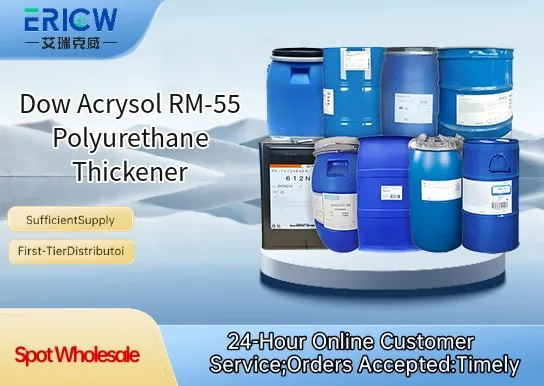
Non-ionic, hydrophobically modified polyurethane (HEUR) rheology modifier
Delivers excellent flow and leveling while maintaining high sag resistance
Compatible with both low-VOC and zero-VOC waterborne formulations
Provides efficient thickening in the presence of surfactants and co-solvents
Enables stable viscosity over wide pH range (pH 4–10)
Architectural interior and exterior flat and low-sheen paints
Waterborne industrial maintenance coatings
Wood coatings requiring balanced rheology and brushability
Stain-blocking primers and dry-fall coatings
Textured decorative wall finishes
| Chemical Type | Hydrophobically Modified Polyurethane (HEUR) |
| Product Form | Clear to slightly hazy liquid |
| Appearance | Light amber to pale yellow viscous liquid |
| Primary Applications | Rheology modifier for waterborne coatings |
| Key Features | Non-ionic, associative thickener |
| Benefits | Improved spatter resistance, anti-settling performance, and post-thickening stability |
| pH Range (as supplied) | 6.5–8.5 |
| Recommended Use Level | 0.2–1.0 wt% (based on total formulation) |
Q1: What type of rheology does RM-55 provide in waterborne coatings?
A: RM-55 is a hydrophobically modified polyurethane (HEUR) thickener that delivers strong pseudoplastic flow behavior, providing excellent sag resistance while maintaining good leveling and spatter control in architectural and industrial waterborne coatings.
Q2: How should RM-55 be incorporated into a formulation?
A: RM-55 is typically added during the let-down stage, after pigment dispersion and before surfactants or other associative thickeners. It should be diluted with water or co-solvent prior to addition and mixed under moderate shear to ensure uniform distribution and optimal associative network formation.
Q3: Is RM-55 compatible with common biocides and surfactants used in latex paints?
A: Yes, RM-55 demonstrates broad compatibility with standard isothiazolinone and formaldehyde-releasing biocides, as well as nonionic and anionic surfactants commonly employed in architectural coatings—though compatibility testing under specific formulation conditions is recommended.
Q4: Does RM-55 require pH adjustment for activation or stability?
A: No, RM-55 is non-ionic and does not rely on pH-sensitive functional groups for thickening performance, making it stable across a wide pH range (typically pH 4–11) without requiring buffering or pH adjustment.
Q5: Can RM-55 be used in combination with cellulosic or acrylic thickeners?
A: Yes, RM-55 is frequently used in hybrid thickener systems to balance viscosity profile, enhance film formation, and improve application properties—however, sequential addition and careful evaluation of synergy and potential antagonism are advised.
Contact With Us:
E-mail: wangxingqiang@ericwchem.com
Have a Questions? Call Us:
Add:
Building A1, Jiete Industrial Park, Huangpu District, Guangzhou City, Guangdong Province, China