English
 Español
 tiếng việt
 русский
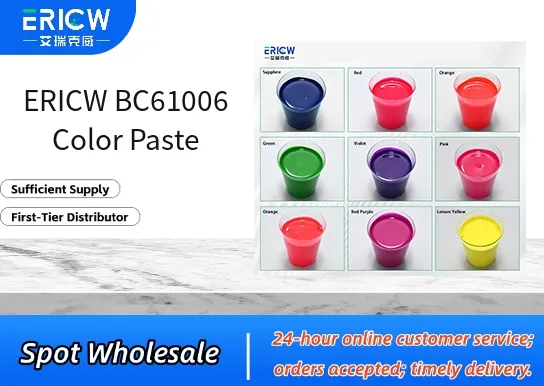
Highly concentrated pigment dispersion for efficient coloration with minimal dosage.
Excellent compatibility with water-based and solvent-based resin systems.
Superior lightfastness and thermal stability up to 180°C during processing.
Low viscosity and excellent flow properties for seamless integration into production lines.
Non-settling formulation ensures long-term storage stability without agitation.
Architectural coatings and decorative wall paints.
Industrial maintenance coatings for metal and concrete substrates.
Plastic coloration for extrusion and injection molding (PVC, ABS, PS).
Printing inks for packaging and label applications.
Wood stains and clear-film finishes requiring transparent color intensity.
| Chemical Type | Organic pigment dispersion in acrylic polymer carrier |
| Product Form | Liquid paste, ready-to-use |
| Appearance | Homogeneous viscous liquid, free of grit or separation |
| Primary Applications | Water-based and solvent-based coatings, plastics, inks |
| Key Features | High chroma, low VOC, non-hazardous classification |
| Recommended Storage | 5–30°C, protect from freezing and direct sunlight |
| pH Value (25°C) | 7.2–8.0 |
| Shelf Life | 24 months from date of manufacture under proper conditions |
Q1: What types of polymer systems is ERICW BC61006 Color Paste compatible with?
A: ERICW BC61006 is formulated for use in thermoplastic polymers including polyolefins (PP, PE), ABS, PS, and certain engineering plastics. It demonstrates good dispersion stability during melt processing and is not recommended for high-temperature engineering resins exceeding 280°C without prior compatibility testing.
Q2: How should ERICW BC61006 be incorporated into a polymer formulation?
A: The paste is typically added directly to the base resin via gravimetric or volumetric dosing systems before extrusion or injection molding. Pre-blending with carrier resin or using masterbatch dilution is advised for optimal dispersion. Avoid prolonged high-shear mixing at elevated temperatures to preserve pigment integrity.
Q3: Is ERICW BC61006 suitable for applications requiring regulatory compliance for food contact or toys?
A: ERICW BC61006 is manufactured using pigments and additives compliant with general safety expectations for indirect food contact and toy materials. However, final regulatory approval depends on the complete formulation, processing conditions, and target market requirements — users must conduct full migration and toxicological assessments as part of their own compliance process.
Q4: What is the typical dosage range for achieving target color intensity?
A: Dosage depends on the base polymer, desired shade depth, and processing method, but ERICW BC61006 is generally used at low concentrations — typically ranging from 0.1% to 2% by weight relative to the total formulation. Lighter tints usually require lower loading, while deep or opaque shades may need optimization through lab-scale trials.
Contact With Us:
E-mail: wangxingqiang@ericwchem.com
Have a Questions? Call Us:
Add:
Building A1, Jiete Industrial Park, Huangpu District, Guangzhou City, Guangdong Province, China