English
 Español
 tiếng việt
 русский
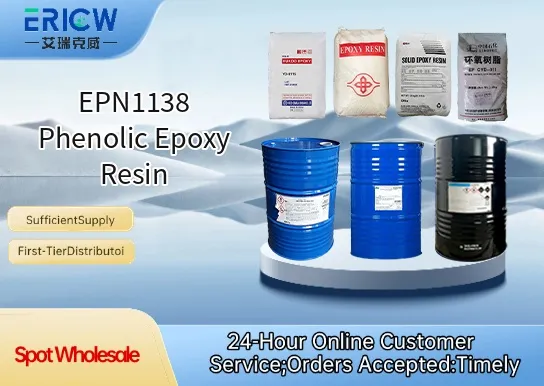
High thermal stability with excellent resistance to elevated temperatures up to 180 °C continuous service.
Superior chemical resistance to strong acids, alkalis, and organic solvents.
Enhanced flame retardancy without halogenated additives — meets UL 94 V-0 when properly formulated.
Low viscosity in molten state, enabling excellent flow and filler wetting for high-solids formulations.
High crosslink density providing exceptional mechanical strength and dimensional stability after cure.
Electrical insulation systems for high-voltage switchgear and dry-type transformers.
Encapsulation and potting compounds for power electronics and EV battery modules.
High-performance composite matrices in aerospace and defense structural components.
Advanced printed circuit board (PCB) laminates requiring low Z-axis expansion and high Tg.
Thermal management adhesives and bonding agents for heat-sensitive electronic assemblies.
| Chemical Type | Novolac-based phenolic epoxy resin |
| Product Form | Pale yellow to amber solid pellets |
| Appearance | Free-flowing granular solid at room temperature |
| Epoxy Equivalent Weight (EEW) | 175–185 g/eq |
| Softening Point | 85–92 °C (ASTM D36) |
| Volatiles Content | ≤ 0.5 wt% (105 °C, 2 h) |
| Color (Gardner Scale) | ≤ 4 |
| Key Features | Halogen-free, high char yield, low moisture absorption |
Q1: What distinguishes EPN1138 from standard bisphenol-A epoxy resins?
A: EPN1138 is a novolac-type phenolic epoxy resin, offering significantly higher functionality and aromatic density than conventional bisphenol-A epoxies. This results in enhanced thermal stability, superior chemical resistance—particularly to strong acids and solvents—and improved char formation under elevated temperatures.
Q2: Is EPN1138 suitable for high-temperature curing systems or post-cure applications?
A: Yes—EPN1138 is specifically designed for high-performance thermoset formulations requiring extended thermal exposure. It exhibits excellent latency with common phenolic hardeners and maintains structural integrity during post-cure cycles above 180 °C, making it well-suited for aerospace composites and high-end electrical encapsulants.
Q3: How does EPN1138 perform in flame-retardant formulations?
A: Due to its high aromatic content and char-forming tendency, EPN1138 contributes inherently to flame retardancy without relying solely on halogenated additives. It is frequently selected as a base resin in low-smoke, zero-halogen (LSZH) systems for wire & cable and rail transportation applications.
Q4: Can EPN1138 be blended with other epoxy resins to modify performance?
A: Yes—EPN1138 is commonly blended with liquid bisphenol-A or bisphenol-F epoxies to balance reactivity, viscosity, and crosslink density. Such blends allow formulators to tailor glass transition temperature, toughness, and processing window while retaining key thermal advantages of the phenolic backbone.
Contact With Us:
E-mail: wangxingqiang@ericwchem.com
Have a Questions? Call Us:
Add:
Building A1, Jiete Industrial Park, Huangpu District, Guangzhou City, Guangdong Province, China